
THEMA North America: Ergonomic Material Handling Solutions for Manufacturing
American factories are spending billions of dollars each year on an injury category that federal agencies have known how to prevent musculoskeletal injuries in manufacturing for decades. Musculoskeletal disorders — the strains, sprains, and chronic damage caused by repetitive lifting, awkward postures, and forceful exertions — remain the most frequently reported cause of lost or restricted work time across U.S. manufacturing. Despite clear guidance from both OSHA and NIOSH on effective ergonomic material handling in manufacturing, injury rates in factories that rely on manual material handling remain stubbornly high. THEMA North America, an engineering-grade provider of ergonomic material handling solutions, works directly with plant managers, EHS directors, and operations leaders to implement the mechanical systems that finally break this cycle. The disconnect between what science knows about preventing these injuries and what most factories actually do about them represents one of the most expensive failures in American industrial operations.
The scope of the problem extends well beyond individual workers dealing with pain and recovery. The CDC’s National Institute for Occupational Safety and Health (NIOSH) identifies musculoskeletal disorders as preventable injuries caused by lifting, bending, reaching, pushing, and pulling heavy loads — noting that exposure to these workplace risk factors significantly increases the probability of injury. NIOSH recommendations for manual material handling consistently identify engineering controls as the gold standard for prevention, above training, rotation, or protective equipment. NIOSH research through its Center for Workers’ Compensation Studies found that one-third of all workers’ compensation claims filed by private employers between 2007 and 2017 were caused by overexertion and bodily reaction. The top industries for how to prevent overexertion injuries in factory settings involve exactly the kind of heavy manual material handling common in manufacturing, warehousing, and delivery operations. For a sector that is already hemorrhaging workers to retirement and losing recruitment battles to competing industries, every preventable musculoskeletal injury represents a compounding crisis.
The True Cost Goes Far Beyond Medical Bills
Understanding how much musculoskeletal injuries cost manufacturers per year requires looking well past the workers’ compensation claim that appears on the insurance ledger. When a machinist tears a rotator cuff lifting heavy stock onto a lathe, or a packaging line operator develops chronic back pain from manual lifting, the visible cost is only the beginning.
Lost productivity accumulates immediately as the injured worker’s position sits empty or gets covered by less experienced personnel who produce at lower rates with higher error frequencies. Overtime pay escalates for remaining staff who absorb the additional workload. Quality defects increase as fatigued workers pulling longer hours make mistakes they would not make under normal conditions. Training costs spike when injured workers decide not to return, choosing instead to leave manufacturing entirely for less physically demanding employment. Insurance premiums rise and persist for years after the incident, punishing the company’s bottom line long after the individual claim closes.
Industry data estimates the average cost of a back injury in a manufacturing facility reaches roughly forty thousand dollars per incident when all direct and indirect costs are calculated. For manufacturers operating on margins of five to ten percent, a handful of serious musculoskeletal injuries per year can eliminate profitability entirely. The manufacturing injury turnover cost becomes especially punishing for small and mid-sized operations where a single experienced worker’s absence can disrupt entire production lines, delay customer shipments, and trigger contractual penalties that compound the original injury expense.
The scale of these losses across American manufacturing is a driving force behind the trends explored in Material Handling Equipment Market Surges Past $230 Billion as Safety and Labor Crises Collide — as manufacturers finally accelerate investments that many should have made years ago.
[IMAGE PLACEMENT 1: A cost breakdown infographic illustrating the $40,000 average workplace injury cost — divided into medical, lost productivity, overtime, training, and insurance premium categories. Alt text: “Manufacturing musculoskeletal injury cost breakdown infographic showing $40,000 average per-incident cost including medical bills, lost productivity, overtime pay, training, and rising insurance premiums”]
Engineering Controls: What Actually Works to Prevent Musculoskeletal Injuries
What is the hierarchy of controls for ergonomic hazards? OSHA’s framework places engineering solutions above administrative measures and personal protective equipment for a fundamental reason. Telling workers how to lift correctly does not eliminate the hazard. Rotating workers between physically demanding tasks merely distributes the damage across a broader population. Providing back braces offers a false sense of security while doing nothing to reduce the forces acting on the spine. The agency’s ergonomic solutions guidance explicitly recommends mechanical devices that lift and tilt materials as the preferred engineering control for reducing material handling injuries in manufacturing environments. OSHA collects and publishes success stories from employers who have implemented these solutions with documented results.
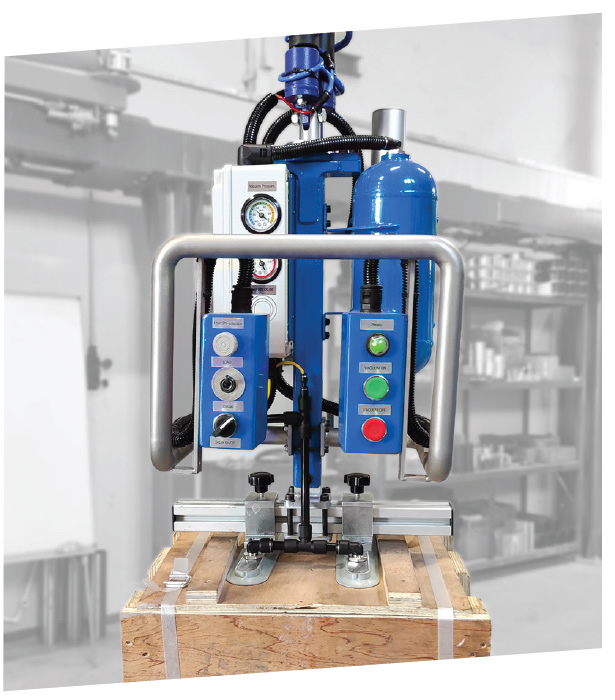
Understanding what engineering controls for ergonomic hazards actually look like in practice is where pneumatic manipulators become central. These systems use compressed air to create a zero-gravity lifting effect, allowing operators to guide loads weighing hundreds or even thousands of pounds with minimal physical effort. The operator controls movement direction and positioning while the pneumatic system manages the weight entirely. This eliminates the forceful exertions, awkward postures, and repetitive strain that directly cause musculoskeletal disorders in manufacturing.
The effectiveness of pneumatic manipulators as engineering controls stems from their complete elimination of the hazard rather than partial mitigation. A worker using a pneumatic manipulator to position a three-hundred-pound component is not lifting three-hundred pounds with better technique. The worker is not lifting three-hundred pounds at all. The pneumatic system bears the load while the worker guides placement with fingertip pressure. This fundamental distinction is precisely why OSHA considers mechanical lifting devices superior to training programs, job rotation schedules, and other administrative approaches — the pneumatic manipulator vs manual lifting safety comparison is not even close when measured by injury incidence data.
Understanding ergonomic equipment investment return on investment in manufacturing becomes straightforward once the full cost picture is laid out. A single serious back injury costing forty thousand dollars can exceed the price of the equipment that would have prevented it. Facilities that handle moderate to heavy loads regularly can expect multiple injury-related incidents annually when relying on manual processes. The equipment pays for itself through injury cost avoidance alone, before accounting for productivity gains of twenty-five to forty percent, quality improvements, and reduced insurance premiums.
This is why THEMA’s zero-gravity lifting systems are engineered to address exactly this class of problem — across automotive manufacturing, food and beverage processing, packaging operations, mechanical engineering, painting and coating, breweries and distilleries, and paper and forestry industries.
OSHA-Hierarchy-Of-Controls-Diagram-Pneumatic-Manipulator-Engineering-Safety
Why Factories Still Rely on Manual Lifting Despite the Evidence
Why are musculoskeletal injuries still so common in manufacturing despite decades of documented prevention strategies? The answers reveal systemic challenges that extend beyond simple cost considerations.
Many manufacturers inherited facility layouts and production processes designed decades ago when labor was abundant and workers’ compensation costs were significantly lower. Retrofitting these environments requires not just equipment purchases but workflow redesign, operator training, and sometimes facility modifications. The upfront investment creates decision paralysis, particularly when competing against other capital requests for production equipment that directly generates revenue. Plant managers often view ergonomic lifting equipment as cost rather than investment — even when the math clearly demonstrates otherwise.
Smaller manufacturers frequently lack dedicated safety professionals who understand the full how to reduce workers’ compensation claims in manufacturing. Plant managers focused on meeting daily production targets see injury costs as occasional and unpredictable rather than systematic and preventable. Without someone in the organization connecting the total cost of musculoskeletal injuries — including the hidden costs of turnover, overtime, quality losses, and premium increases — to the investment required for ergonomic material handling solutions for mid-size manufacturers, the status quo persists until a serious incident forces reactive action.
The labor shortage itself paradoxically works against ergonomic investment in manufacturing in some operations. Manufacturers running short-staffed cannot easily pull workers from production for equipment training or process transitions. This creates a destructive cycle where understaffing increases individual workload and injury risk, injuries further reduce the available workforce, and remaining workers absorb even more physical strain. How to break the cycle of manufacturing worker injuries and turnover requires recognizing that the short-term disruption of implementing ergonomic equipment prevents the far greater ongoing disruption of continuous injuries, turnover, and declining morale.
Exploring 2.1 Million Manufacturing Jobs at Stake: How Smart Lifting Equipment Bridges the Labor Gap reveals how forward-thinking manufacturers are using ergonomic material handling technology to break free from this destructive pattern and turn workforce challenges into competitive advantages.
The Regulatory Trajectory Is Clear: OSHA Ergonomics Enforcement in 2026
Understanding OSHA ergonomics requirements for manufacturing facilities in 2026 is no longer optional for risk management teams. OSHA’s enforcement posture on ergonomic hazards has shifted noticeably toward greater scrutiny and more aggressive action. The agency’s 2026 updates to the 30-hour outreach training program include expanded sections on ergonomic hazard recognition and musculoskeletal injury prevention — reflecting a regulatory priority that is only gaining momentum.
OSHA musculoskeletal disorder recordkeeping requirements in 2026 remain fully in force under existing recordkeeping regulations. While the formal MSD recordkeeping column rule was withdrawn in July 2025, employers remain fully obligated to record musculoskeletal injuries that meet standard OSHA criteria and face citations under the General Duty Clause when recognized lifting hazards go unaddressed. OSHA General Duty Clause ergonomics enforcement examples are accumulating — and Amazon’s December 2024 settlement is the most prominent signal yet of where enforcement is heading.
Amazon’s December 2024 settlement with OSHA over ergonomic injuries at its U.S. warehouses and fulfillment centers required implementation of adjustable workstations, ergonomic mats, harnesses, and job rotation protocols. The precedent established by this high-profile enforcement action makes clear what federal regulators consider adequate ergonomic intervention — and OSHA ergonomics compliance through mechanical lifting aids sits at the top of that list. Manufacturers relying on manual lifting hazards for tasks that mechanical aids could perform face increasing regulatory risk as enforcement precedents accumulate and OSHA inspectors apply these standards more broadly.
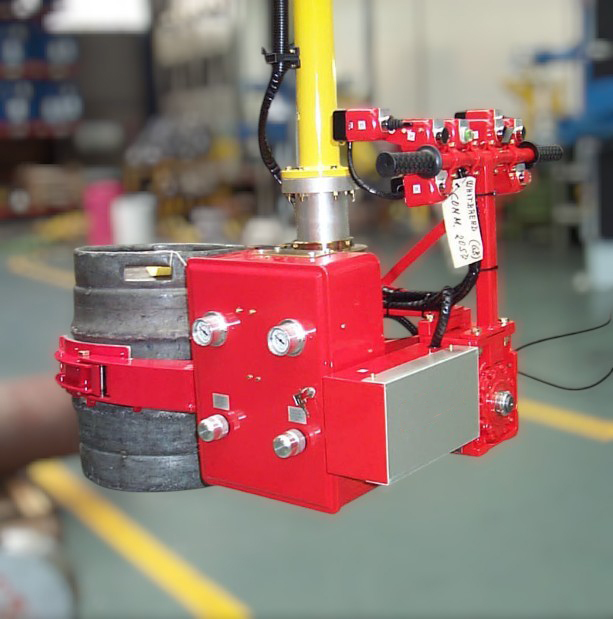
The window for voluntary ergonomic improvement is narrowing. Manufacturers who invest in pneumatic manipulators and lift-assist devices now position themselves ahead of tightening enforcement while simultaneously solving their productivity and retention challenges. THEMA’s professional installation support and ongoing maintenance programs ensure that ergonomic engineering controls deliver reliable, documentable performance — the kind of evidence that satisfies both insurance carriers and OSHA inspectors.
Thema-North-America-Pneumatic-Manipulator-Ergonomic-Engineering-Controls
THEMA North America: Your Partner in Ergonomic Material Handling
THEMA North America delivers engineering-grade pneumatic manipulators that eliminate manual lifting hazards while increasing production throughput across every shift. Our zero-gravity lifting systems make heavy loads feel weightless — protecting workers, reducing workers’ compensation exposure, and satisfying OSHA’s engineering control requirements in a single investment.
Our Solutions Include:
- Pneumatic Manipulators — Zero-gravity lifting systems with custom grippers for loads from 60 kg to 1,850 kg
- Automotive Manufacturing Solutions — High-cycle ergonomic handling for automotive production environments
- Food & Beverage Processing Solutions — Hygienic, USDA-compatible systems for sensitive processing facilities
- Packaging Operations Solutions — Throughput-optimized lift-assist systems for packaging lines
- Mechanical Engineering Solutions — Precision handling for machined components and tooling
- Industries We Serve — Ergonomic handling solutions across every major manufacturing vertical
- Professional Installation — Expert commissioning to ensure systems perform from day one
- Ongoing Maintenance Programs — Maximize uptime and protect your investment for the long term
Ready to Eliminate Manual Lifting Hazards? Contact THEMA North America to discuss how our ergonomic material handling equipment can protect your workforce and reduce injury costs.
FAQs Section
Q1: What are musculoskeletal disorders and why are they so common in manufacturing?
Musculoskeletal disorders (MSDs) are injuries to muscles, tendons, ligaments, nerves, and spinal discs caused by repetitive physical stress. They are the leading cause of lost work time in U.S. manufacturing because factory jobs consistently involve the primary risk factors: heavy lifting, bending, awkward postures, and repetitive forceful motions performed across long shifts without mechanical assistance.
Q2: How much do musculoskeletal injuries cost manufacturers per incident?
The average workplace musculoskeletal injury costs approximately $40,000 per incident in direct and indirect costs, including medical expenses, lost productivity, overtime for replacement workers, retraining costs, and rising insurance premiums. For facilities experiencing several incidents per year, the cumulative cost can eliminate annual profitability entirely.
Q3: What does OSHA’s hierarchy of controls recommend for ergonomic hazards in manufacturing?
OSHA places engineering controls at the top of its hierarchy for ergonomic hazard prevention. Mechanical lifting devices — such as pneumatic manipulators, zero-gravity lifters, and lift-assist systems — are the preferred intervention because they eliminate the hazardous lifting force entirely. Training programs, job rotation, and personal protective equipment are ranked below engineering controls because they reduce exposure without eliminating the hazard.
Q4: How do pneumatic manipulators prevent musculoskeletal injuries in factories?
Pneumatic manipulators use compressed air to counterbalance the full weight of a load, making heavy components feel weightless to the operator. Rather than physically lifting hundreds of pounds, the worker guides the load into position with fingertip pressure. This completely eliminates the spinal loading, shoulder stress, and postural strain that cause musculoskeletal injuries — making pneumatic manipulators the most effective available engineering control for manual material handling hazards.
Q5: What is the ROI on ergonomic lifting equipment for manufacturing facilities?
A single serious back injury costing $40,000 can exceed the full installation cost of a pneumatic manipulator. When facilities handling heavy loads regularly account for multiple annual injury incidents — plus the compounding costs of turnover, overtime, quality losses, and rising premiums — ergonomic equipment typically pays for itself within the first year of operation through injury cost avoidance alone, before counting productivity gains of 25–40%.
Q6: What are OSHA’s ergonomics enforcement priorities for manufacturing in 2026?
OSHA has expanded ergonomic hazard recognition content in its 2026 30-hour training program and continues enforcing ergonomic violations under the General Duty Clause, which requires employers to address recognized hazards. Amazon’s December 2024 settlement over warehouse ergonomic injuries established a high-profile precedent for what regulators consider adequate intervention, signaling more aggressive enforcement across the manufacturing sector.
Q7: Why do so many manufacturers still rely on manual lifting despite documented risks?
Common barriers include inherited facility layouts designed before ergonomic standards existed, decision paralysis over upfront equipment costs, lack of internal safety expertise to quantify the full injury cost picture, and understaffing that makes process transitions difficult. The result is a destructive cycle where injuries worsen the labor shortage that was already making the facility hard to operate.
Q8: How does ergonomic equipment investment affect manufacturing insurance premiums?
Insurance carriers are increasingly scrutinizing ergonomic hazard controls during underwriting and risk assessments. Manufacturers that implement mechanical lifting aids — the preferred engineering control under OSHA’s hierarchy — may qualify for measurable workers’ compensation premium reductions. These savings compound annually and can meaningfully accelerate return on investment beyond productivity gains alone.
Works Cited
“About Ergonomics and Work-Related Musculoskeletal Disorders.” National Institute for Occupational Safety and Health, Centers for Disease Control and Prevention, www.cdc.gov/niosh/ergonomics/about/index.html. Accessed 25 Feb. 2026.
“Ergonomics – Solutions to Control Hazards.” Occupational Safety and Health Administration, U.S. Department of Labor, www.osha.gov/ergonomics/control-hazards. Accessed 25 Feb. 2026.
Related Articles
- Material Handling Equipment Market Surges Past $230 Billion as Safety and Labor Crises Collide
- 2.1 Million Manufacturing Jobs at Stake: How Smart Lifting Equipment Bridges the Labor Gap