
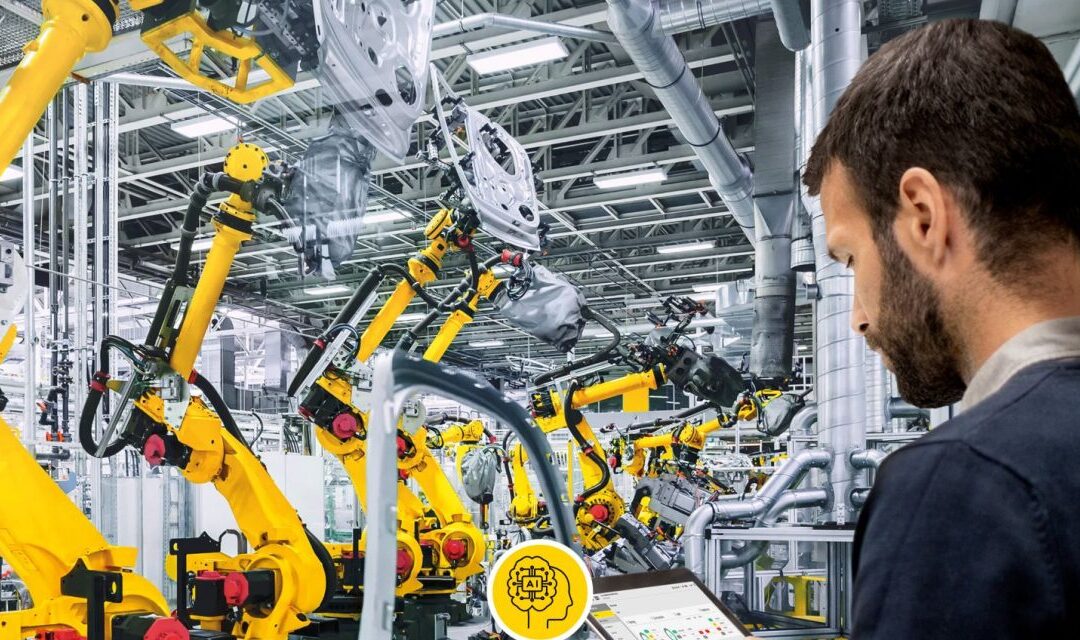
The robotics narrative in manufacturing is compelling—and it is consistently oversold. Trade publications catalog every autonomous guided vehicle deployment, every robotic arm partnership announcement, and every warehouse automation milestone with a cumulative effect that projects a factory floor where manual labor has been rendered optional and full automation manages every material movement seamlessly. The operational reality that plant managers navigate daily in 2026 looks considerably different from that projection. Most manufacturing environments involve variable load types, mixed product runs, frequent changeovers, and floor configurations that make full robotic automation either technically impractical for realistic near-term implementation, economically out of reach within honest capital planning horizons, or both simultaneously.
What is actually happening on North American factory floors right now is more instructive than any press release suggests: facilities across every size category are implementing pneumatic manipulators and ergonomic lift-assist technology as the fast-deploy, cost-effective solution that resolves today’s injury burden and throughput constraints without the 12 to 18 month capital approval cycles, systems integration timelines, and operational disruption that full robotic implementations consistently require. The ergonomic material handling equipment market reached $32.7 billion globally in 2024 and is expanding at a 7.8 percent compound annual growth rate through 2033—growth being driven not by large-scale robotics projects but by plant managers at every level choosing engineering solutions that work within operational reality rather than projections built for ideal conditions.
The NIOSH ergonomics program framework at the CDC provides the scientific foundation underlying this investment trend: engineering controls that physically eliminate hazardous exposures through equipment are categorically more effective and more durable than administrative controls like training rotations, modified work schedules, or procedure changes that leave the underlying hazard in place and depend entirely on behavioral consistency that fatigued workers cannot reliably sustain across full production shifts day after day.
Key Takeaways
- Robots deliver on high-volume, single-SKU lines — but most North American plants run variable loads, mixed products and frequent changeovers, where pneumatic manipulators win.
- Manipulators handle mixed runs and changeovers without reprogramming or cell reconfiguration.
- No code, servos or specialized technicians — a practical fit for the many mid-size plants that can’t staff robotics support.
- They fit operating budgets instead of large capital-integration projects.
- By removing the manual lift, they cut overexertion and MSD injuries where full automation isn’t practical.
The Robotics Gap Most Plant Managers Already Understand
Robotics investments are announced publicly with optimistic timelines attached. The timeline slippage, programming overruns, integration challenges, and scope reductions that follow tend to stay inside the building. Engineers and operations managers who have personally worked through full robotic automation projects understand the gap between vendor projections and production floor reality: programming cycles that routinely extend well beyond scheduled completion dates, system sensitivity to product variation that generates constant reconfiguration demands, and ongoing maintenance requirements that assume specialized technician availability that many smaller and mid-size manufacturers simply cannot staff or retain at a cost that fits within operating budgets.
This is not a categorical argument against robotic automation as a technology class. For high-volume, tightly repetitive, single-SKU applications where product specifications remain stable across long production runs and capital budgets support the full cost of integration, commissioning, and ongoing technical support, robotic automation delivers exactly the efficiency gains it promises. The problem is that the majority of North American manufacturing operations in 2026 do not match that profile in any meaningful way. Food and beverage operations run seasonal product rotations with changing packaging configurations throughout the year. Packaging facilities handle multiple SKUs with different weights, dimensions, and fragility requirements that shift from order to order. Paper and forestry operations manage roll sizes that vary continuously by customer specification. Job-shop machining environments reconfigure production setups on daily or weekly cycles. In all of these contexts, the ability to adapt handling equipment rapidly to changing production conditions is worth as much or more than marginal gains in raw throughput—and it is precisely where pneumatic manipulators hold a decisive and durable operational advantage over programmed robotic systems that require re-engineering every time the product changes.
Pneumatic manipulators are operator-guided by fundamental design principle. Adapting to a new product, a different load geometry, or a changed production sequence requires appropriate gripper hardware for the new application and operator familiarization with the configuration—not a software development engagement, not a systems integrator scheduling call, not a multi-week validation and commissioning cycle that takes the line down. Configuration changes that would require coordinating a robotics integration team take a capable maintenance technician an afternoon to complete and verify.
What the Injury Data Is Communicating to Operations Leaders
OSHA’s 2024 Injury Tracking Application release, drawing on submissions from more than 370,000 employers across U.S. industries, confirms manufacturing’s persistent position among the highest-risk sectors for serious workplace incidents. Nearly one-third of all serious workplace injuries across industries involve musculoskeletal disorders—the overexertion strains, chronic back injuries, and progressive shoulder damage that accumulate from repetitive manual lifting performed without mechanical assistance over sustained production periods. OSHA serious-category violations carried fines exceeding $15,000 per incident going into 2026, with repeat violations drawing escalating enforcement attention and reputational consequences that compound well beyond initial penalty costs.
Workers’ compensation costs for MSD claims run substantially above other injury categories because of the extended recovery timelines and return-to-work complexity associated specifically with back and shoulder injuries. Lost-time claims frequently extend across multiple months. Modified duty arrangements introduce their own administrative and productivity costs throughout the return-to-work process. Retraining upon return consumes supervisor and peer time that was already committed to production demands. For most manufacturing operations, a pneumatic manipulator system that demonstrably prevents two or three MSD claims annually—each carrying combined direct and indirect costs that routinely exceed the equipment purchase price on their own—achieves full positive return on investment before the end of the second operating year. That financial logic holds consistently across sectors, facility sizes, production volumes, and product types. The injury exposure is not sector-specific. Neither is the solution.
For the complete analysis of MSD trends in manufacturing and the full operational and workforce consequences for facilities that do not address them, see Manufacturing’s MSD Crisis: Why Industrial Manipulators Are Now a Survival Strategy.
THEMA North America, headquartered in Harleysville, PA, is the sole North American distributor for Italian-engineered THEMA manipulator systems. The product line spans 60 kg to 1,850 kg with reaches up to 6 meters. Gripper solutions are custom-engineered for each specific application—vacuum systems for bags, boxes, glass, and flat goods; jaw grippers for clamping; expanding mandrels for rolls and drums; magnetic attachments for ferrous materials; and full 360-degree rotation and tilt capability for complete load positioning control in any orientation. Every unit ships CE and ATEX certified, load-tested at 2x and 3x rated capacity before leaving the production facility. Installation completes in one to two days on-site. Operators reach full working proficiency within a single shift. No software. No integration layer. No specialized maintenance staff required.
Our Services Include:
- Industrial Manipulators — Full product line from 60 kg to 1,850 kg engineered for every industrial lifting application across every production sector
- Maintenance Program — Ongoing service and technical support designed to maximize equipment uptime and extend operational lifespan across years of production use
Ready to see how pneumatic manipulators fit your specific facility, application, and budget? Contact THEMA North America
Frequently Asked Questions
Why choose pneumatic manipulators over full robotic automation?
For facilities with variable loads, mixed product runs, or frequent changeovers, robotics’ 12-to-18-month capital approval and systems-integration timelines are often impractical. Pneumatic manipulators need no programming — reconfiguring for a new product can happen in an afternoon.
How big is the ergonomic material handling equipment market?
It reached $32.7 billion globally in 2024 and is growing at a 7.8% compound annual rate through 2033.
What could it cost a facility if OSHA cites an ergonomic hazard?
OSHA serious-category violations carried fines exceeding $15,000 per incident heading into 2026 — on top of the underlying injury cost itself.
Can one system handle multiple gripper types for different products?
Yes — vacuum systems, jaw grippers, expanding mandrels, and magnetic attachments are all available with full 360-degree rotation, so the same base unit adapts across product lines.
How quickly can operators become proficient?
Most reach full working proficiency within a single shift, since there’s no programming or specialized robotics training involved.
Works Cited
“Elements of Ergonomics Programs.” Centers for Disease Control and Prevention, National Institute for Occupational Safety and Health, www.cdc.gov/niosh/ergonomics/ergo-programs/index.html. Accessed 23 Mar. 2026.
“US Department of Labor Releases 2024 Injury, Illness Data.” Occupational Safety and Health Administration, U.S. Department of Labor, www.osha.gov/news/newsreleases/osha-trade-release/20250417. Accessed 23 Mar. 2026.
Related Articles
- Manufacturing’s MSD Crisis: Why Industrial Manipulators Are Now a Survival Strategy
- The $41 Billion Market Shift: Why Manufacturers Are Choosing Pneumatic Manipulators Over Manual Lifting