
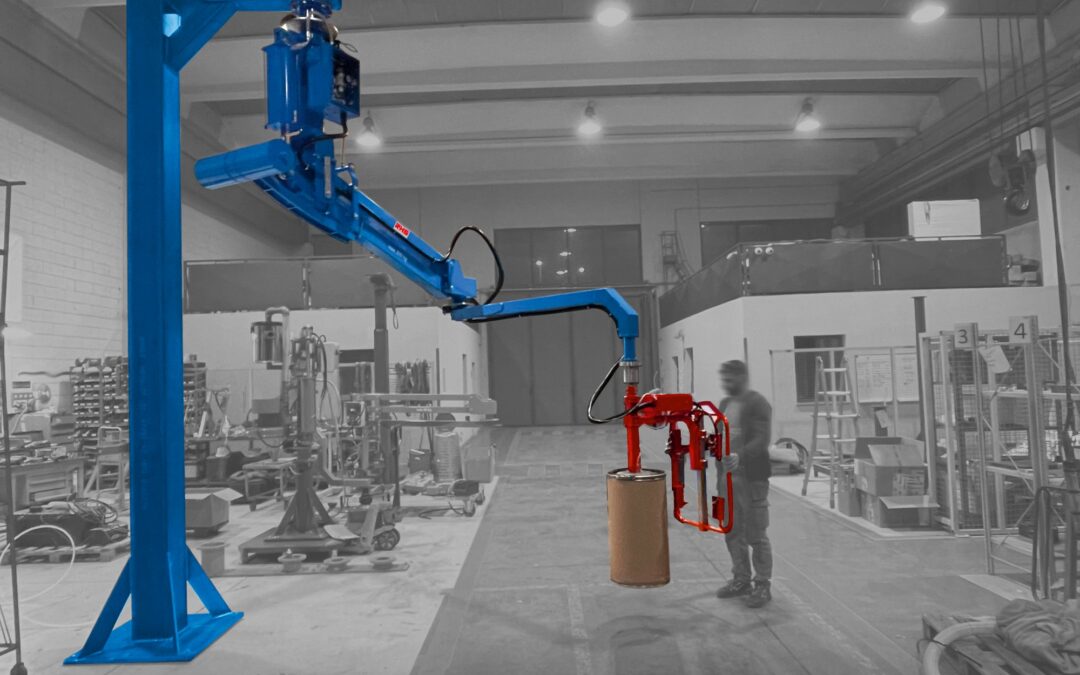
THEMA North America: Engineered Pneumatic Manipulators for Modern Manufacturing
The robotics industry is having a record year. The International Federation of Robotics reported in January 2026 that the global market value of industrial robot installations reached an all-time high of $16.7 billion, with factories worldwide installing 542,076 industrial robots in 2024 alone — more than double the volume from a decade earlier. Global robot density has hit 162 units per 10,000 employees, AI-powered autonomy is advancing rapidly, and humanoid robots are moving from prototypes to early industrial deployment. THEMA North America, a provider of precision pneumatic manipulator systems for mid-market manufacturing, works alongside plant managers and operations directors who are navigating this automation landscape every day — and what those conversations consistently reveal is a gap between the robotics headlines and the factory floor equipment reality for most American manufacturers.
The headlines are impressive. The reality for most mid-size American manufacturers is considerably less glamorous. While Fortune 500 companies with dedicated automation engineering departments and multi-year integration budgets are deploying cutting-edge robotic systems, the majority of U.S. manufacturers — companies with 50 to 500 employees generating $10 million to $200 million in annual revenue — face a fundamentally different manufacturing automation decision in 2026. These manufacturers need material handling solutions that work now, not solutions that require 18 months of programming, six-figure integration consulting fees, and specialized technicians to maintain. For this vast middle market, pneumatic manipulators are quietly delivering the productivity and safety gains that full robotics promises but rarely achieves at comparable cost or speed.
The True Cost of Industrial Robotics: What the Sticker Price Doesn’t Tell You
How much does industrial robot installation really cost for manufacturing? The sticker price of an industrial robot is just the beginning. A standard six-axis robotic arm suitable for material handling applications runs $50,000 to $150,000 for the base unit. Collaborative robots designed for safe operation alongside human workers start around $25,000 to $50,000 but have payload limitations that exclude many manufacturing handling tasks. Turnkey robotic cells with conveyors, safety systems, and custom programming routinely exceed $500,000 for complex applications — making industrial robot total cost of ownership a very different number from the quoted hardware price.
Then come the costs that robot vendors mention only in footnotes. Industrial robot programming costs for manufacturing facilities typically run 20 to 50 percent of the robot’s base price, with complex cells pushing that figure to 50 to 100 percent. End effectors — the grippers and tooling that allow robots to grasp specific parts — add $5,000 to $25,000 each, and most production environments require multiple configurations. Training operators to manage robotic systems requires days of dedicated instruction, and ongoing support contracts add recurring annual costs that compound over the equipment’s life.
How long does it take to deploy an industrial robot in manufacturing? The timeline is equally sobering. From purchase order to full production deployment, robotic material handling systems typically require six to eighteen months of integration work. During that window, the productivity problem the robot was supposed to solve continues burning money every shift. For a manufacturer that needs relief from manual handling injuries and bottlenecks now, a robotic solution that starts delivering ROI a year from now is not really a solution at all.
The broader economic context makes these timelines even more consequential. The Federal Reserve Bank of Cleveland’s analysis of reshoring workforce dynamics documents that U.S. manufacturing employment fell by 6.6 million jobs from 1979 to 2025 even as total national employment grew by 68 million. How reshoring affects manufacturing equipment decisions in 2026 is a strategic question every plant manager is now answering — and the answer demands equipment that delivers productivity immediately from available workers, not equipment that promises productivity after extended integration. Equipment choices that deliver immediate productivity gains are not a luxury. They are a strategic necessity for manufacturers competing in the reshoring era.
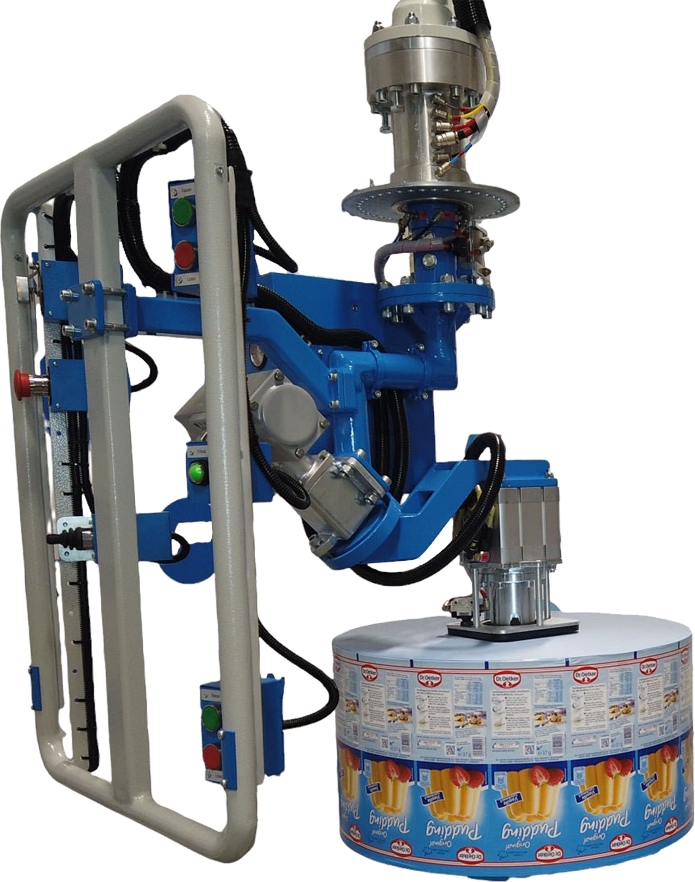
Industrial-Robot-Pneumatic-Manipulator-Cost-Comparison-2026
Where Pneumatic Manipulators Win: Speed, Cost, and Factory Floor Fit
Pneumatic manipulators vs. industrial robots occupy fundamentally different positions in the equipment landscape. Rather than replacing human workers, pneumatic manipulators augment human capability — providing the lifting force, precision positioning, and fatigue elimination that allow a single operator to handle loads of 100 to 1,500 pounds with fingertip control and zero physical strain.
How quickly can pneumatic manipulators be installed in a factory? The deployment speed advantage stands out immediately. A pneumatic manipulator typically installs in days, not months. There is no programming required, no integration consulting, and no specialized software to configure. Pneumatic manipulator operator training is measured in hours — not the days of dedicated instruction that robotic systems require. A manufacturer who orders a pneumatic manipulator in March can have it handling production loads by April, a timeline that no industrial robot deployment can match for comparable handling tasks.
Pneumatic manipulator cost vs. robotics favors pneumatic systems by a wide margin for material handling applications. Where a robotic cell with equivalent payload capacity might cost $200,000 to $500,000 fully installed, a pneumatic manipulator system delivering comparable handling capability typically runs $15,000 to $75,000 depending on capacity and customization. Understanding the pneumatic manipulator payback period in manufacturing is straightforward: at a fraction of the robotic cost with immediate deployment, these systems frequently pay for themselves within months rather than years.
The maintenance profile is equally favorable. Pneumatic systems have fewer moving parts, no servo motors to fail, no software to update, and no control electronics vulnerable to tariff-inflated component costs. For mid-market manufacturer capital equipment decisions where total lifecycle cost matters as much as purchase price, this maintenance simplicity is a decisive advantage.
These cost and deployment advantages matter enormously given the broader market dynamics. Understanding Reshoring Surge Forces U.S. Manufacturers to Rethink Factory Floor Equipment reveals that manufacturers across every sector are reaching the same conclusion: the reshoring wave demands equipment that delivers productivity immediately, not equipment that promises productivity after years of integration.
THEMA’s pneumatic manipulator solutions are deployed across manufacturing verticals including automotive, food and beverage, packaging operations, mechanical engineering, painting and coating, breweries and distilleries, and paper and forestry industries — and across all of them, the deployment and cost profile is consistent.
Flexibility That Robots Cannot Match: The High-Mix, Low-Volume Reality
One of the most overlooked advantages of pneumatic manipulators is their adaptability to high-mix, low-volume manufacturing environments — precisely the manufacturing model that dominates mid-size American factories. Understanding what equipment mid-size manufacturers use for material handling reveals why flexibility is the determining factor that full robotics consistently fails to satisfy.
A pneumatic manipulator with interchangeable end tooling can handle castings in the morning, sheet metal assemblies after lunch, and finished components before end of shift. Changing the task requires swapping a gripper attachment, not reprogramming a robot. This is the defining practical advantage of pneumatic manipulators vs. cobots and industrial robots for manufacturers whose product mix changes weekly, batch sizes range from dozens to hundreds, and customer specifications evolve continuously.
Collaborative robot limitations for manufacturing applications become most apparent in exactly these high-mix scenarios. Reprogramming a robot for each new configuration is technically possible but economically impractical at the volumes most mid-size manufacturers handle. The cobot vs. pneumatic manipulator question for flexible production environments almost always resolves in favor of pneumatic systems when the full cost of reconfiguration is counted.
Pneumatic systems also preserve the human judgment that complex handling tasks require. An experienced operator using a manipulator can feel when a part seats correctly, adjust positioning intuitively based on visual cues, and adapt instantly when fixtures vary or tolerances shift. This sensory feedback loop is something that even the most advanced robotic vision and force-sensing systems struggle to replicate — and when they do replicate it, the cost premium eliminates any ROI advantage.
How to handle heavy components in manufacturing without a robot is a question mid-size manufacturers answer every day with pneumatic lift-assist systems — achieving the ergonomic lifting equipment benefits of reduced strain and improved throughput without the programming complexity or integration cost that robotics requires.
The Human Factor Is the Point: Why Pneumatic Manipulators Solve the Skills Problem
The IFR’s 2026 trend report identifies manufacturing labor shortages as a primary driver of robot adoption, noting that employers worldwide struggle to find people with specialized skills. But for mid-size manufacturers, the irony is that industrial robots often exacerbate the skills problem. Operating and maintaining industrial robots requires programming knowledge, systems integration expertise, and troubleshooting capabilities that are even scarcer than the production workers the robots were supposed to replace.
Pneumatic manipulators flip this dynamic entirely. They require no programming expertise, minimal maintenance knowledge, and operator training that any production worker can complete in a single shift. Instead of creating new skill dependencies, they enhance the capabilities of existing workers. A manufacturer who cannot find enough skilled operators can make each existing operator substantially more productive with a manipulator — handling heavier loads, working faster, sustaining output through full shifts without fatigue-driven slowdowns, and avoiding the injuries that pull trained workers off the line.
How pneumatic manipulators improve worker safety and productivity simultaneously is what makes them the right fit for manufacturing automation options for companies under 500 employees who cannot afford the specialized talent that robotic systems demand. Understanding how to increase factory throughput without full automation consistently leads operations managers back to the same conclusion: pneumatic lift-assist systems deliver immediate, measurable gains from the workforce already in place.
The demographic reality of who is available to work in American manufacturing reinforces this advantage. As detailed in Manufacturing’s Aging Workforce Is Rewriting the Rules on Factory Floor Safety, the production workforce is older than it has ever been, with injury severity increasing alongside age. Equipment that keeps experienced older workers productive and healthy extends their careers and preserves their irreplaceable process knowledge. A robot replaces a worker. A pneumatic manipulator extends one.
The injury prevention dimension of this comparison connects directly to manufacturing’s broader cost structure. As explored in Manufacturing’s Ergonomic Crisis: Why Musculoskeletal Injuries Still Cost American Factories Billions, every preventable injury that sidelines a production worker costs $40,000 or more — and ergonomic lift-assist devices that eliminate manual handling hazards represent the most cost-effective prevention strategy available.
Finding factory floor automation solutions near Pennsylvania and across North America has become a priority for manufacturers who need immediate productivity gains without the integration complexity of full robotics. THEMA’s professional installation team ensures systems are operational on day one, and our ongoing maintenance program keeps them performing reliably for years — without the specialized robotics technicians that industrial systems require.
The Bottom Line for Mid-Size Manufacturing Operations
Full industrial robotics has its place in manufacturing — high-volume automotive lines, semiconductor fabrication, and other applications where the investment in programming, integration, and maintenance pays off over millions of identical cycles. But for the majority of mid-size American manufacturers handling diverse products at moderate volumes, pneumatic manipulators deliver faster deployment, lower total cost, greater flexibility, and immediate productivity gains that robotic systems simply cannot match at comparable price points.
What equipment do mid-size manufacturers use for material handling when they have run the full cost and timeline comparison? Increasingly, the answer is pneumatic lift-assist systems — deployed in days, operated by existing workforce, maintained with existing skills, and delivering 25 to 40 percent throughput gains without the six-figure integration bill or 18-month timeline that robotics requires.
The factories that will thrive through the reshoring wave, the aging workforce transition, and the tariff volatility of 2026 will not necessarily be the most automated. They will be the most intelligently equipped — matching the right tool to the right task and the right workforce.
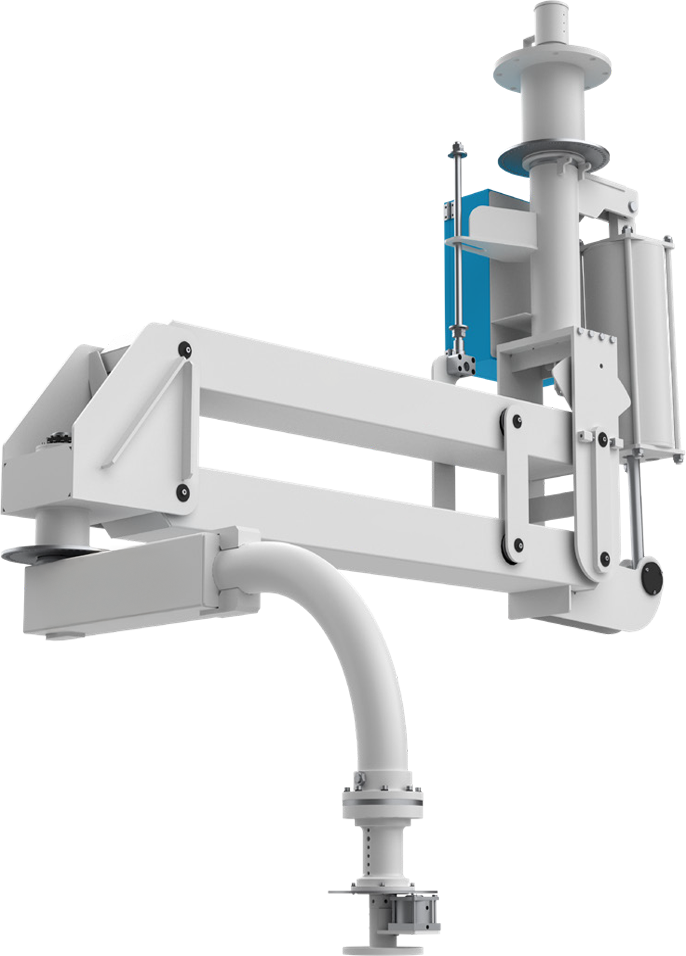
Pneumatic-Manipulator-Operation-Mid-Size-Manufacturing-Facility-Efficiency
THEMA North America: Engineered Solutions for Modern Manufacturing
THEMA North America provides pneumatic manipulators engineered to outperform complex automation for material handling tasks where human skill, flexibility, and speed of deployment matter most. Our systems deliver immediate productivity gains without the integration timelines, programming costs, or maintenance complexity of industrial robotics — and our applications team works directly with plant managers and operations directors to match the right system to every production requirement.
Our Solutions Include:
- Pneumatic Manipulators — Precision lifting and positioning systems with payloads from 10 to 1,500 pounds, deployable in days with operator training measured in hours
- Automotive Manufacturing Solutions — High-cycle ergonomic handling engineered for demanding automotive production environments
- Food & Beverage Processing Solutions — Hygienic, USDA-compatible lift-assist systems for sensitive processing facilities
- Packaging Operations Solutions — High-throughput handling for packaging line productivity demands
- All Industries We Serve — Ergonomic handling solutions across every major manufacturing vertical
- Professional Installation — Expert commissioning ensuring systems perform from day one
- Ongoing Maintenance Programs — Long-term reliability without specialized technician dependency
Contact THEMA North America to discuss which manipulator configuration fits your production requirements and how quickly we can get it on your factory floor.
FAQ Section
Q1: How do pneumatic manipulators compare to industrial robots for mid-size manufacturers?
Pneumatic manipulators typically cost $15,000 to $75,000 fully installed and deploy in days, while comparable industrial robotic cells cost $200,000 to $500,000 and require six to eighteen months of integration. For mid-size manufacturers with high-mix, low-volume production, pneumatic systems offer greater flexibility, faster ROI, simpler operator training, and lower maintenance complexity — without the programming expertise or specialized technicians that robotics require.
Q2: What is the total cost of ownership of an industrial robot for manufacturing?
Beyond the base hardware cost of $50,000 to $150,000 for a six-axis arm, manufacturers must budget for end effectors ($5,000–$25,000 each), installation and programming (20–100% of hardware cost), operator training, ongoing support contracts, and integration consulting. For complex handling cells, all-in costs routinely exceed $500,000 — with an 18-month timeline before full production deployment begins generating ROI.
Q3: How quickly can a pneumatic manipulator be installed in a manufacturing facility?
A pneumatic manipulator typically installs and reaches full production operation in days, not months. There is no programming required, no integration consulting, and no specialized software configuration. Operator training typically takes a single shift. A manufacturer who orders in March can realistically have the system handling production loads by April — a deployment timeline no industrial robot system can match.
Q4: Why are pneumatic manipulators better than robots for high-mix, low-volume manufacturing?
Industrial robots excel at repetitive, identical tasks executed thousands of times per cycle. High-mix, low-volume manufacturers change tasks frequently — sometimes multiple times per shift. Pneumatic manipulators adapt through simple gripper swaps requiring no reprogramming, allowing operators to handle castings, sheet metal, and finished components in the same shift. The flexibility that robots require expensive reconfiguration to achieve comes standard with pneumatic systems.
Q5: Do pneumatic manipulators require specialized operators or maintenance technicians?
No. Pneumatic manipulators require no programming expertise, and operator training typically takes a few hours to complete a standard shift. Maintenance relies on the same mechanical and pneumatic knowledge most manufacturing facilities already have in-house. This contrasts sharply with industrial robots, which require programming knowledge, systems integration expertise, and troubleshooting capabilities that are even scarcer than production workers in the current labor market.
Q6: What payload capacities do pneumatic manipulators handle for manufacturing applications?
THEMA North America’s pneumatic manipulator systems handle payloads from 10 to 1,500 pounds (approximately 60 kg to 1,850 kg for metric applications), with custom gripper configurations engineered for specific component geometries and material types. This range covers the vast majority of manual handling tasks in mid-size manufacturing across automotive, packaging, food processing, mechanical engineering, and general industrial applications.
Q7: How do pneumatic manipulators support the reshoring manufacturing trend in 2026?
The reshoring wave is creating immediate demand for factory floor equipment that increases productivity from available workers without months of integration delay. Pneumatic manipulators deploy in days, require no programming expertise, and deliver 25–40% throughput gains from existing workforce — matching the speed and flexibility that reshoring manufacturers need as they bring domestic production online under aggressive timelines.
Q8: Can pneumatic manipulators help manufacturers comply with OSHA ergonomic requirements?
Yes. Pneumatic manipulators are engineering controls — the highest tier of OSHA’s hierarchy of controls — because they eliminate the manual lifting hazard rather than merely reducing exposure to it. For manufacturers facing ergonomic scrutiny under OSHA’s General Duty Clause, or seeking to reduce workers’ compensation costs from musculoskeletal injuries, pneumatic manipulators provide documented hazard elimination that satisfies regulatory requirements while delivering immediate productivity gains.
Works Cited
“Top 5 Global Robotics Trends 2026.” International Federation of Robotics, 8 Jan. 2026, ifr.org/ifr-press-releases/news/top-5-global-robotics-trends-2026. Accessed 25 Feb. 2026.
Whitaker, Stephan D. “Where Could Reshoring Manufacturers Find Workers?” Federal Reserve Bank of Cleveland, Cleveland Fed District Data Brief, 9 Oct. 2025, www.clevelandfed.org/publications/cleveland-fed-district-data-brief/2025/cfddb-20251009-where-could-reshoring-manufacturers-find-workers. Accessed 25 Feb. 2026.
Related Articles
- Reshoring Surge Forces U.S. Manufacturers to Rethink Factory Floor Equipment
- Manufacturing’s Aging Workforce Is Rewriting the Rules on Factory Floor Safety