
Key Takeaways
- Manufacturing’s workforce is aging, and older workers face more severe injuries when hurt, even if injury frequency doesn’t rise as sharply.
- OSHA enforcement is increasingly focused on ergonomic hazards, raising compliance stakes for employers with aging workforces.
- Veteran workers carry irreplaceable institutional knowledge — protecting their bodies protects that knowledge.
- Adapting equipment, not just policy, is what actually reduces injury severity for older workers.
- The demographic shift is already underway, not a future risk to plan around later.
The Gray Shift on the Factory Floor
American manufacturing has an age problem that most companies are only beginning to confront. The workers who built the country’s industrial capacity over the past three decades are not being replaced at anywhere near the rate they are retiring — and the employees who remain are getting older every year. THEMA North America, a provider of engineering-grade ergonomic material handling solutions based in Harleysville, PA, works directly with plant managers and EHS directors who are grappling with this demographic reality on their floors every shift. The consequences for factory floor safety, productivity, and equipment strategy are profound — and most manufacturers are dangerously behind in adapting to how the aging workforce affects manufacturing safety in 2026.
The U.S. Census Bureau reported in December 2025 that the aging of firm workforces has been particularly rapid in production sectors. In manufacturing specifically, the share of total employment at firms where at least one-quarter of workers are over age 55 surged from 14 percent in 2000 to over 40 percent by 2022 — nearly tripling in just two decades. This is not a gradual demographic drift. It is a structural transformation of who is actually doing the physical work in American factories, and it carries direct implications for what safety equipment for aging manufacturing workforces those factories need. The manufacturing workforce demographics statistics in 2026 show a median worker age exceeding 44, compared to 42 for the total labor force. By 2030, one in five Americans will be 65 or older — meaning the workers filling physically demanding factory jobs are not just older on average, they are concentrated in the roles where material handling injuries are most common and most costly.
Older Workers, More Severe Injuries: Understanding the Age-Injury Cost Relationship
Why are older manufacturing workers more likely to have severe injuries? The relationship between worker age and injury severity is well documented and alarming. Research consistently shows that while older manufacturing workers do not necessarily sustain more injuries than younger colleagues, the injuries they do sustain are significantly more severe. Recovery times are longer. Lost workdays multiply. Workers’ compensation costs escalate. Studies have found that injury costs for workers over 45 are roughly three times higher than for workers under 30 performing comparable tasks in physical occupations.
This severity differential hits manufacturers where it hurts most: experienced employees sidelined for extended periods, institutional knowledge pulled off the production floor, and soaring insurance premiums that compress already tight margins. Understanding how older workers affect workers’ compensation costs in manufacturing is no longer a back-office actuarial question — it is a front-line operations and finance priority. A 55-year-old machinist with 25 years of process expertise who tears a rotator cuff lifting a heavy component is not just an injury statistic. That absence creates cascading production problems that no amount of overtime from remaining staff can fully offset.
The pattern is particularly dangerous for material handling tasks. Research on aging workforce physiology shows that older workers select maximum acceptable lift masses that are on average 24 percent lower than younger workers. Muscle fatigue develops faster, particularly in the shoulder and trapezius regions. Joint mobility declines, especially in the cervical spine and wrists. These are not abstract findings — they describe exactly the physical demands imposed on workers who spend shifts lifting, positioning, and moving components without mechanical assistance. Understanding how ergonomic equipment reduces injury recovery time for older workers is becoming a standard line item in every serious manufacturing safety program.
The scale of these demographic changes is a driving force behind the trends explored in Material Handling Equipment Market Surges Past $230 Billion as Safety and Labor Crises Collide — as companies building and modernizing domestic facilities discover that equipping for an aging manufacturing workforce is no longer optional, it is a baseline requirement for operational viability.
Aging-Workforce-Safety-Equipment-Urgency-Manufacturing-Injury-Costs
OSHA’s Enforcement Landscape Raises the Stakes for Aging Workforce Employers
Manufacturers who assume they can manage aging-workforce injury risks through training and administrative controls alone are ignoring the regulatory reality. The Occupational Safety and Health Administration’s penalty structure has been ratcheting upward annually, with maximum fines for serious violations reaching $16,550 per violation as of January 2025 and willful or repeated violations carrying penalties up to $165,514 each. OSHA’s 2026 agenda specifically emphasizes expanded inspections and stricter enforcement in manufacturing, with heightened attention to injury and illness reporting and documentation.
OSHA’s July 2025 penalty guideline updates signal a dual-track approach. While the agency expanded penalty reductions for small employers who demonstrate good faith and immediate corrective action, it simultaneously made clear that employers who fail to address known hazards — particularly those causing repeated injuries — face escalating consequences. OSHA requirements for aging workforce safety in manufacturing are enforced primarily through the General Duty Clause, which requires employers to maintain workplaces free from recognized hazards likely to cause death or serious physical harm.
Amazon’s December 2024 settlement over warehouse ergonomic conditions established a significant precedent: OSHA is willing to pursue large-scale ergonomic enforcement actions, and the agency views the availability of mechanical handling solutions as evidence that manual lifting hazards are both recognized and preventable. For manufacturers with aging workforces performing repetitive heavy lifting, the regulatory calculus is clear. Ergonomic safety equipment that eliminates manual handling hazards is no longer just an injury prevention investment — it is a compliance strategy that reduces exposure to citations, penalties, and the reputational damage that follows publicized OSHA actions.
THEMA’s solutions align directly with OSHA’s engineering control hierarchy — the same framework that governs ergonomic enforcement. Every pneumatic manipulator installation is supported by THEMA’s professional commissioning team to ensure systems perform to specification from day one, and ongoing support through our maintenance program keeps systems compliant and operational for years.
The Knowledge Drain: Why Every Veteran Worker’s Body Matters More Than You Think
The aging workforce crisis in manufacturing extends far beyond physical injury risk. Every week, skilled manufacturing workers with decades of hands-on experience retire permanently. The Manufacturing Institute estimates that lack of knowledge transfer costs large businesses $47 million annually in wasted time, missed opportunities, and delayed projects. Understanding knowledge transfer in an aging manufacturing workforce requires recognizing that this is not just a training and documentation problem — it is an injury prevention problem.
This institutional knowledge drain makes every remaining experienced worker more valuable — and every injury that sidelines one more damaging. How to retain experienced manufacturing workers longer is ultimately the same question as how to prevent the injuries that force early exits. A manufacturer who loses a veteran CNC operator to a preventable material handling injury is not just paying medical bills and workers’ compensation. They are losing process expertise that took 20 years to develop and that no training program can replicate on a timeline that matters for current production commitments.
Equipment that keeps experienced workers healthy and productive on the factory floor serves a dual purpose: it prevents the immediate costs of injury while preserving the institutional knowledge that enables quality, efficiency, and troubleshooting capabilities. A pneumatic manipulator that allows a 58-year-old fabricator to continue doing precision positioning work without destroying their shoulders is not just an ergonomic intervention. It is a knowledge retention strategy — and one with a measurable ROI that most manufacturers have not yet fully calculated.
The full range of ergonomic material handling solutions THEMA delivers is designed with exactly this dual purpose in mind: protecting worker bodies while preserving the experienced judgment and process intuition that took decades to build. Across automotive manufacturing, food and beverage processing, packaging operations, mechanical engineering, painting and coating, breweries and distilleries, and paper and forestry operations, the pattern is consistent: veteran workers who can keep working safely are the most valuable asset on the floor.
Understanding the specific equipment categories gaining traction in this environment helps clarify why certain solutions fit better than others. Exploring Why Pneumatic Manipulators Are Outperforming Full Robotics for Mid-Size Manufacturers reveals how the most practical aging workforce safety equipment solutions prioritize human skill and judgment while eliminating the physical strain that drives injuries and early retirements.
How to Adapt Factory Equipment for an Aging Workforce: What Actually Works
What equipment helps older manufacturing workers avoid injury? The answer is not more training, better back braces, or additional administrative controls. OSHA’s hierarchy of controls is explicit: engineering solutions that eliminate the hazard entirely are superior to any mitigation approach. For manufacturing material handling, that means pneumatic manipulators and zero-gravity lifting systems that remove the physical load from the worker’s body entirely.
How to adapt factory floor equipment for an aging workforce starts with identifying where the physical load is highest relative to worker capability. In most manufacturing environments, this means component lifting, positioning during assembly, and transferring materials between process stages. Zero-gravity lifting systems for aging factory workforces operate on compressed air infrastructure that most facilities already have in place — eliminating the installation complexity of robotic alternatives while delivering immediate, measurable relief from the manual lifting forces that cause musculoskeletal injuries.
Ergonomic lift-assist devices for physically demanding factory jobs scale from loads as light as 60 kg to systems handling over 1,850 kg, with custom gripper configurations engineered for specific components and applications. This means the same platform that protects a 52-year-old automotive line worker positioning engine blocks also protects the 60-year-old fabricator guiding sheet metal through a press brake. The equipment adapts to the work, allowing experienced workers to continue performing the skilled tasks they know best without the physical cost that once made those tasks unsustainable.
Ergonomic material handling for workforce retention in manufacturing is increasingly how forward-thinking plant managers are framing these capital expenditure requests. The ROI calculation connects directly: a facility that loses a senior operator to injury or retirement-accelerating physical strain faces months of lost productivity, expensive recruiting, and extended training. Equipment that prevents that outcome pays for itself in the first incident it prevents — before counting the throughput gains of 25 to 40 percent that manufacturers consistently report after pneumatic manipulator implementation.
Finding factory floor safety solutions for aging workforces near Pennsylvania and across North America is increasingly straightforward as the market has caught up with the urgency of the demographic shift. The more important question is no longer where to find the equipment — it is whether manufacturers will act before the next injury forces the decision at premium cost and reduced options.
Also see Manufacturing’s Ergonomic Crisis: Why Musculoskeletal Injuries Still Cost American Factories Billions for a deeper look at the injury cost structures that make this equipment investment so financially compelling.
The Demographic Clock Is Not Waiting
Manufacturing cannot recruit its way out of this problem. Understanding the manufacturing retirement wave and baby boomer impact makes this clear: the pipeline of younger workers entering production careers remains insufficient to replace retiring baby boomers, and the workers who are available increasingly expect workplaces designed to protect their long-term physical health. Manufacturers who equip their facilities to accommodate the physical realities of an aging manufacturing workforce will retain experienced employees longer, reduce the injury severity that devastates production schedules, lower workers’ compensation costs, and position themselves as employers that younger workers actually want to join.
The manufacturing workforce demographics data in 2026 is not ambiguous. Manufacturing’s workforce is older than it has ever been, concentrated in the most physically demanding roles, and aging faster than the broader economy. Every factory in America that still relies on manual material handling for heavy components is operating on borrowed time — borrowed from workers’ bodies, from OSHA’s enforcement patience, and from a labor market that offers fewer replacement workers every year. The manufacturers who act on this reality now — investing in aging manufacturing workforce safety equipment that matches their team’s actual physical capabilities — will be the ones still running full production schedules five years from now.
Industrial-Glass-Manipulator-Manufacturing-Safety-Lift-Assist
THEMA North America: Engineered Solutions for Modern Manufacturing
THEMA North America provides pneumatic manipulators and ergonomic material handling systems engineered to protect aging manufacturing workforces while maximizing production output. Our equipment enables experienced operators to continue performing precision tasks safely — preserving the institutional knowledge that drives manufacturing quality while eliminating the physical strain that forces premature exits from the workforce.
Our Solutions Include:
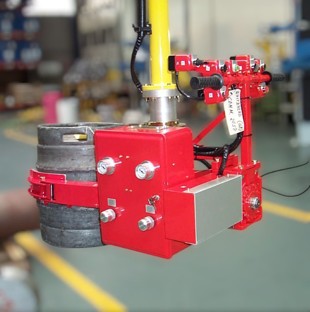
- Pneumatic Manipulators — Zero-gravity lifting and positioning systems that eliminate manual strain for workers of all ages and physical capabilities (60 kg to 1,850 kg)
- Automotive Manufacturing Solutions — High-cycle ergonomic handling engineered for automotive production demands
- Food & Beverage Processing Solutions — Hygienic, USDA-compatible lift-assist systems for food production environments
- Packaging Operations Solutions — Throughput-optimized handling for high-cycle packaging lines
- Mechanical Engineering Solutions — Precision component handling for machined parts and tooling
- Industries We Serve — Ergonomic handling solutions across every major manufacturing vertical
- Professional Installation — Expert commissioning ensuring systems perform correctly from day one
- Ongoing Maintenance Programs — Long-term reliability to protect your workforce and your investment
Contact THEMA North America to discuss how our handling equipment can help your operation adapt to workforce demographics while maintaining production targets.
FAQs Section
Q1: How does an aging manufacturing workforce affect factory floor safety?
As manufacturing workers age, their risk of severe musculoskeletal injuries increases significantly. Research shows injury costs for workers over 45 are approximately three times higher than for workers under 30 performing comparable physical tasks. Older workers also experience faster muscle fatigue, reduced joint mobility, and lower maximum acceptable lift capacities — making manual material handling increasingly hazardous as the workforce ages.
Q2: Why are injuries more severe for older manufacturing workers than younger ones?
Older workers experience age-related physiological changes including reduced muscle mass, slower recovery rates, decreased joint mobility, and longer tissue healing timelines. While they may not sustain injuries more frequently than younger workers, when injuries do occur they result in significantly more lost workdays, higher medical costs, and greater workers’ compensation expense — often removing experienced workers from production for weeks or months.
Q3: What is the best ergonomic safety equipment for an aging manufacturing workforce?
Pneumatic manipulators and zero-gravity lifting systems are the most effective ergonomic safety equipment for aging manufacturing workforces because they eliminate the physical lifting load entirely rather than reducing it. Under OSHA’s hierarchy of controls, engineering solutions that remove the hazard are ranked above all administrative controls. These systems allow workers of any age and physical capability to handle loads from 60 kg to over 1,850 kg without the spinal loading, shoulder strain, or repetitive stress that causes musculoskeletal injuries.
Q4: How do pneumatic manipulators help manufacturers retain experienced older workers?
Pneumatic manipulators remove the physical barriers that force experienced workers into early retirement or disability leave by eliminating the heavy lifting that accumulates injury risk over years of work. When a 55-year-old operator can continue performing precision positioning tasks without destroying their joints, the manufacturer retains decades of process expertise, troubleshooting capability, and production knowledge that no training program can quickly replace.
Q5: What are OSHA’s current enforcement priorities for aging workforce safety in manufacturing?
OSHA’s 2026 agenda emphasizes expanded manufacturing inspections with heightened attention to injury and illness reporting. Maximum penalties for serious violations reached $16,550 per violation in 2025, with willful or repeated violations carrying penalties up to $165,514. The General Duty Clause remains OSHA’s primary enforcement tool for ergonomic hazards, and Amazon’s December 2024 settlement over ergonomic injuries established a clear precedent for what regulators consider adequate intervention.
Q6: How much does the manufacturing knowledge drain cost companies annually?
The Manufacturing Institute estimates that inadequate knowledge transfer costs large businesses $47 million annually in wasted time, missed opportunities, and delayed projects. When veteran workers leave due to preventable material handling injuries — rather than planned retirement — that knowledge loss is uncontrolled and unplanned, creating immediate production disruptions that compound the direct injury costs.
Q7: Can ergonomic equipment investment reduce workers’ compensation premiums for manufacturers?
Yes. Insurance carriers are increasingly factoring ergonomic engineering controls into their underwriting decisions for manufacturers. Facilities that implement mechanical lifting aids — particularly pneumatic manipulators that eliminate rather than reduce manual lifting hazards — may qualify for workers’ compensation premium reductions that compound annually. For facilities with aging workforces where injury severity and cost multipliers are highest, these savings can be substantial.
Q8: What percentage of U.S. manufacturing workers are now over age 55?
As of 2022, over 40 percent of U.S. manufacturing firms had at least one-quarter of their workforce over age 55 — nearly triple the 14 percent figure recorded in 2000. The median age of a manufacturing worker now exceeds 44. By 2030, one in five Americans will be 65 or older, meaning the demographic pressure on manufacturing safety equipment needs will only intensify through the remainder of this decade.
Works Cited
“Firms in Production Sectors and Northern States Have Some of the Highest Shares of Older Workers.” U.S. Census Bureau, 18 Dec. 2025, www.census.gov/library/stories/2025/12/older-workers.html. Accessed 25 Feb. 2026.
“OSHA Penalties.” Occupational Safety and Health Administration, U.S. Department of Labor, www.osha.gov/penalties. Accessed 25 Feb. 2026.
Related Articles
- Reshoring Surge Forces U.S. Manufacturers to Rethink Factory Floor Equipment
- Why Pneumatic Manipulators Are Outperforming Full Robotics for Mid-Size Manufacturers