
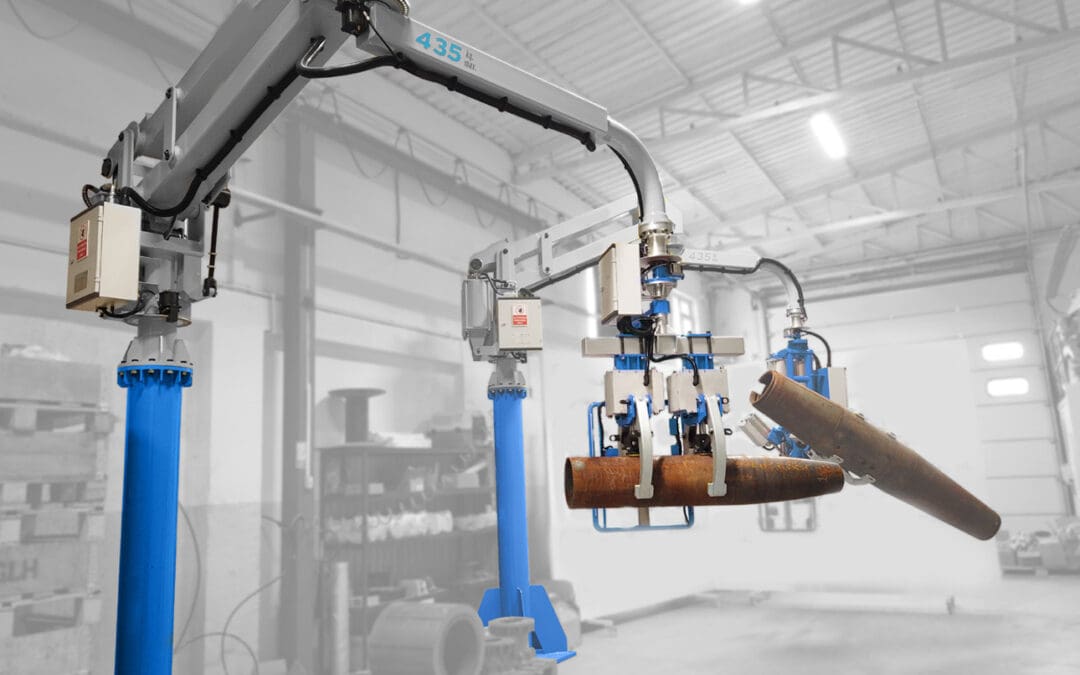
Short answer: A custom gripper needs a full application review whenever load geometry, center of gravity, surface condition, required rotation, reach, or operator motion changes enough that payload alone no longer proves the tool will control the part safely. If the current gripper leaks, binds, drifts, damages product, or forces awkward handling, treat it as an application-fit problem, not a minor tooling tweak.
Start with the task, not the payload
Industrial buyers often begin with the part weight, but that is only one input. THEMA’s guide to choosing end-of-arm tooling for a pneumatic manipulator frames tooling selection around the load’s geometry, surface, motion, and ergonomic risk, not around weight alone. That matters because two parts with the same weight can demand very different grip methods if one is porous, off-center, fragile, slippery, or needs controlled rotation during placement.
A full application review is usually warranted when a buyer is changing any of the conditions that define control of the load: where the gripper contacts the part, how stable the part remains through travel, whether the operator must rotate or tilt the load, and how the tooling interacts with the manipulator arm and workstation. THEMA’s application scoping guidance is useful here because it pushes the buyer to define the handling task before requesting equipment.
What details usually force a full review?
- Part geometry or center of gravity changes
- Grip surfaces become less reliable because of coating, dust, oil, moisture, or porosity
- The operator now needs more reach, vertical travel, or rotation than the current tool was designed for
- The end effector itself adds enough weight or bulk to change balance and clearance
- The part must be handled faster, more frequently, or in a tighter workstation envelope
Those changes are exactly why a custom gripper review should stay tied to the full application rather than be treated as a stand-alone accessory decision.
What warning signs show the current gripper is no longer a fit?
In real plants, a full review is often triggered by operating symptoms rather than a new product launch. If the gripper has recurring air leaks, binding, drift, chatter, or inconsistent release, buyers should pause before approving another quick modification. The same is true when operators need extra force to guide the tool, when product contact points are leaving marks, or when the team keeps adding small field fixes just to keep the task running.
These symptoms usually mean the issue is broader than wear alone. The grip method may no longer match the part, the motion path may exceed what the tooling can control smoothly, or the workstation may be asking the operator to compensate for poor application fit. THEMA’s pneumatic manipulator overview emphasizes controlled, ergonomic, zero-gravity handling. If the tool is fighting that goal, the buyer should revisit the application assumptions before approving fabrication or refurbishment.
What safety questions belong in the review?
A custom gripper review should also answer a simple question: what happens if something goes wrong mid-cycle? OSHA’s machine guarding rule, 29 CFR 1910.212, requires protection from machine hazards created by points of operation, ingoing nip points, rotating parts, flying chips, and sparks. For gripper design, that means the review should identify pinch zones, rotating elements, and any motion that could expose the operator’s hands during grip, transfer, or release.
Buyers should also ask how the tool behaves during air loss, pressure drop, or partial grip failure. A credible review does not stop at “it can lift the part.” It should explain how the part stays controlled, how accidental release risk is reduced, and what the operator is expected to do if the cycle is interrupted. That is especially important when the gripper must rotate a part, carry it through crowded space, or place it near fixed tooling.
How should operator motion and workflow shape the decision?
OSHA’s ergonomics guidance and the National Institute for Occupational Safety and Health’s ergonomics resources both point employers toward engineering controls when lifting, forceful exertion, awkward posture, and repetitive motion create musculoskeletal disorder risk. That matters in gripper review because a tool can be mechanically sound and still be a poor choice if it forces wrist deviation, long reaches, extra corrections, or unstable part presentation.
For that reason, buyers should watch the entire handling path, not only the pickup point. Can the operator approach the load naturally? Does the tool keep the part oriented so placement is smooth? Does the handle position let the worker guide the part without twisting? Does the release step require a sudden posture change? A full review is justified whenever the answer to those questions becomes less predictable, because workflow friction often shows up before an obvious failure.
What should a supplier be able to show before you approve?
Before approving a custom gripper, ask the supplier to walk through the application in a structured way: the part description, pickup surfaces, center of gravity, required motions, clearances, operator position, and failure-response logic. The buyer should also understand why the proposed grip method is the best fit. Vacuum, jaw, hook, mandrel, and magnetic concepts solve different problems, so the proposal should show why the chosen method fits this exact load and process.
If the application is changing materially, a broader assessment may be the smarter next step than approving tooling in isolation. THEMA’s automation readiness assessment is one way to review the handling task, workflow, and equipment fit before the gripper is finalized.
The practical takeaway is simple: approve a custom gripper only after the design has been reviewed as part of the full handling system. When the load, motion, operator path, or failure consequences change, the gripper decision is no longer just about fabrication. It is an application decision.