
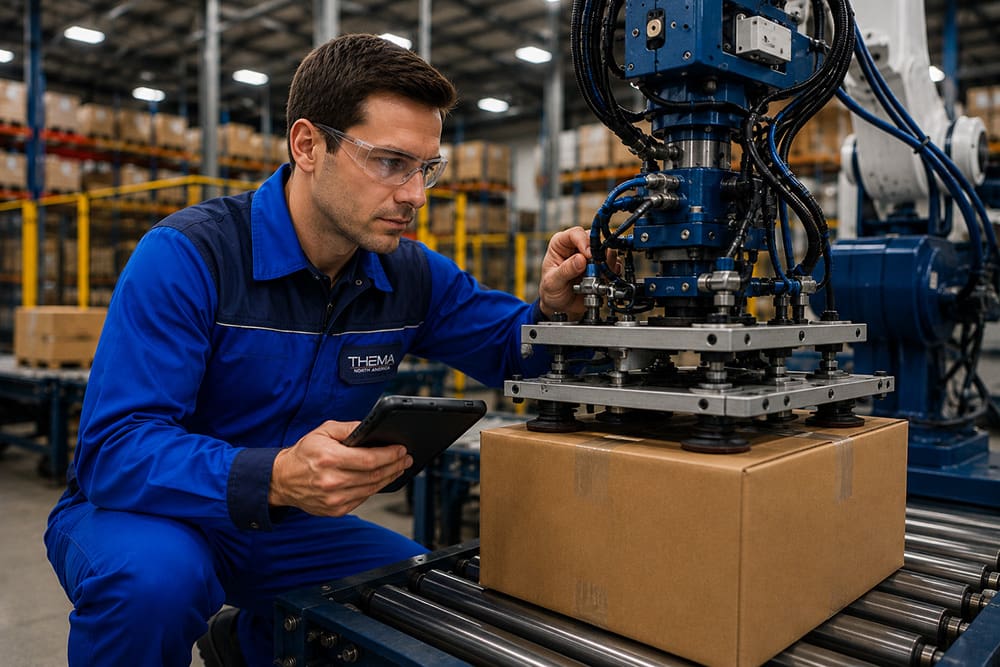
The best end-of-arm tooling is the tool that matches how the part must be gripped, rotated, protected, and released in the real workstation. Start with the load’s geometry, surface, center of gravity, part variation, required motion, and environment, then choose the simplest tooling that can hold the product securely without damaging it or forcing awkward operator posture. NIOSH guidance also supports using mechanical assists to reduce lifting strain when tasks involve weight, reach, twist, or repetition (NIOSH Guidelines; NIOSH Lifting Equation Manual).
Why tooling selection matters more than many buyers expect
When buyers compare manipulators, they often start with lift capacity and reach. Those matter, but the tooling determines whether the operator can actually pick the part, keep it stable through motion, and place it accurately without product damage. THEMA’s public product materials show that the company offers pneumatic, vacuum, magnetic, and end-of-arm tooling configurations for different handling problems, not one universal head for every application (THEMA Products; THEMA Pneumatic Manipulators).
That is why the right question is not Which manipulator has the highest rating. It is Which gripping method matches this product, this motion, and this workstation?
What gripper is right for your product?
Use the product itself to narrow the answer. NIOSH’s lifting guidance treats grip quality, reach, twisting, and lift frequency as major risk factors in manual handling, which makes the gripping method important for both safety and productivity (NIOSH Lifting Equation Manual).
Vacuum tooling
Best for relatively stable surfaces such as cartons, sheet material, panels, or other products that can hold vacuum consistently. Vacuum tooling is often attractive when you need clean top or side pickup and gentle handling. It is a weaker fit for porous, leaking, heavily textured, or shape-shifting surfaces unless the application has been tested carefully.
Jaw or clamp grippers
Best for irregular parts, boxes, drums, mechanical components, and products that need positive side grip. On THEMA’s automotive page, vacuum systems, magnetic grippers, jaw grippers, and custom hooks are presented as different answers for different part types, which is the right way to think about selection (THEMA Automotive Manipulators).
Hooks, forks, and mandrels
Best when the product already has a reliable lift feature or internal core. Rolls, bobbins, and similar loads often make sense with mandrel-style or hook-based engagement because the load path is obvious and repeatable. These tools can be simple and robust, but only if the lift point and part orientation are consistent.
Magnetic tooling
Best for ferrous parts where secure magnetic engagement is practical and the surface condition supports it. If the part is coated, non-ferrous, or highly variable, magnetic tooling may not be the first choice. THEMA’s product portfolio specifically separates magnetic manipulators from other product families, which is a reminder that material type can be the deciding factor (THEMA Products).
What application details should you confirm before specifying tooling?
Before you request a recommendation, gather the facts that change tooling design:
- Part weight range, not just nominal weight
- Dimensions, shape variation, and center of gravity
- Approved grip points and no-touch surfaces
- Whether the part needs rotation, tilt, or orientation control
- Required pick and place heights, reach, and cycle frequency
- Surface condition such as oily, painted, wet, porous, or fragile
- Environmental conditions such as washdown, dust, or hazardous areas
- How the part must behave if air, vacuum, or power is interrupted
If that sounds like a lot, it is because gripper choice is an application-engineering task, not a catalog checkbox. THEMA’s own quote-preparation guidance is useful here: define load, motion, operator demands, and environmental constraints before asking for pricing so the recommendation matches the real job (How to Scope a Pneumatic Manipulator Application Before You Request a Quote).
How do ergonomics and safety affect gripper choice?
Tooling is not only about holding the part. It also affects wrist posture, reach distance, rotation effort, and how repeatable the lift is across a full shift. NIOSH’s Ergonomic Guidelines for Manual Material Handling recommend identifying high-risk tasks and reducing physical demands with engineering changes and mechanical lifting devices rather than relying only on training or operator effort (NIOSH Ergonomic Guidelines for Manual Material Handling). The Revised NIOSH Lifting Equation also treats coupling quality, horizontal reach, asymmetry, and frequency as variables that directly change risk (Applications Manual for the Revised NIOSH Lifting Equation).
For buyers, that means a technically workable gripper is not automatically the right gripper. If the tool forces awkward hand position, unstable rotation, extra reaching, or operator compensation to keep the load balanced, the application still needs work. The better answer is usually the tool that creates predictable pickup and controlled placement with the least operator strain.
When should you ask for a complete integrated solution?
If your part is fragile, off-center, slippery, varies by SKU, or must be presented at a precise angle, it usually makes sense to evaluate the manipulator and the tooling as one system. THEMA’s public pages consistently position its solutions around application-specific handling rather than generic lifting alone (THEMA Pneumatic Manipulators). That is especially true when the project also involves mounting, layout, installation, or long-term service planning.
A practical next step is to share part photos, dimensions, weight range, pick points, desired motion, and workstation constraints, then compare tooling options against the real process instead of against brochure language. If you are ready to move from research to application review, start with THEMA’s Request a Quote page after collecting the scoping details above.