
Food Manipulator: The Complete Guide to Safe, Hygienic Lifting in Food & Beverage Manufacturing

When the Flour Bag Is 50 kg, and the Shift Is 8 Hours
Here’s a scenario that plays out in food plants every single day:
A worker is on their third hour of lifting 50-kg flour sacks. Their back started talking to them around hour two. By the afternoon break, they’re moving more slowly, getting less precise, and becoming increasingly likely to drop something or get dropped themselves. And somewhere in the plant manager’s morning report tomorrow, there will be an incident to explain.
Manual ingredient handling in food and beverage manufacturing is one of the most physically demanding tasks in the North American industry. Repetitive, heavy, and relentless, it’s the kind of work that quietly builds toward workers’ comp claims, labor turnover, and production bottlenecks.
A food manipulator solves all three of those problems at once. At Thema North America, we work with food and beverage manufacturers across the United States, Canada, and Mexico to design and install ergonomic handling systems that protect workers, meet FDA and USDA hygiene requirements, and genuinely pay for themselves.
This is the complete guide to what food manipulators are, how they work, what they handle, and how to choose the right one for your facility.
What Is a Food Manipulator?
A food manipulator is a specialized industrial lifting and positioning device designed specifically for the hygiene, load, and handling demands of food and beverage production environments.
Like all industrial manipulators, it allows one operator to lift, move, tilt, rotate, and precisely place loads that would be unsafe or impossible to handle manually, but a food-grade industrial manipulator goes further: it’s engineered from materials and to tolerances that meet FDA, USDA, and HACCP food safety standards.
Key characteristics of food manipulators:
- Material: Stainless steel (SS304 or SS316) construction for washdown and corrosion resistance
- Surface finish: Electropolished or smooth-ground finishes that prevent bacterial harboring
- IP rating: IP65 or higher, fully sealed against water ingress from cleaning and sanitation cycles
- End-of-arm tooling: Customized grippers, suction cups, or clamps made from food-safe materials (FDA-approved rubber, stainless, food-grade nylon)
- Load capacity: 10 kg to 500+ kg, covering everything from single ingredient bags to full drums
- Drive type: Pneumatic, most common (no electrical risk in wet environments); electric available for precision applications
What food manipulators handle in typical food plants:
- Bulk ingredient sacks: flour, sugar, salt, rice, coffee (25–50 kg each)
- Ingredient drums and barrels: oils, syrups, flavor concentrates (50–500 kg)
- Glass bottles, jars, and containers (fragile; breakage = contamination)
- Kegs, casks, and barrels in breweries and distilleries
- Finished product crates, cases, and packaging units
- Ingredient bags and big bags (supersacks) at receiving
Explore Thema’s pneumatic manipulators for food and beverage processing →
Why Food & Beverage Plants Can’t Afford Manual Lifting Anymore
The food and beverage industry has a workplace injury problem that most plant managers know about, but few have fully solved.
According to OSHA, musculoskeletal disorders (MSDs), sprains, strains, and repetitive motion injuries caused by manual material handling are the single largest category of recordable injuries in food processing. The average MSD claim costs between $15,000 and $80,000 when you count medical costs, lost productivity, replacement labor, and the downstream impact on your Experience Modification Rate (EMR).
But the real cost isn’t just the claim, it’s the rate increase that follows.
Raise your EMR, and your workers’ comp premium climbs, not just for the claim year, but for three years afterward. One bad season of manual handling injuries can add tens of thousands of dollars to your annual insurance cost.
Learn how Thema’s ergonomic material handling solutions protect workers across industries →
Beyond injury costs, there’s the contamination risk. A fatigued worker drops a glass jar. A mishandled drum spills syrup across a food-contact surface. A torn ingredient bag releases flour into a production area. All of these are avoidable, and a sanitary food manipulator eliminates the handling errors that cause them.
How Do Food Manipulators Improve Workplace Safety?
This is the question every food plant EHS manager needs a direct answer to, so here it is:
A food manipulator improves workplace safety by mechanically absorbing 100% of the load’s weight, removing physical strain from the operator on every single lift, while preserving their ability to precisely guide, position, and orient the load.
In practical terms, here’s what that means on your production floor:
1. Elimination of Repetitive Strain Injuries: Lifting 50-kg ingredient sacks, even 20 times a shift, creates cumulative spinal loading that leads to disc injuries. An ergonomic food manufacturing manipulator handles that load on every cycle, preventing the damage that builds over weeks and months into a workers’ comp claim.
2. Reduced Contamination Risk from Handling Errors: Manipulators provide controlled, consistent handling; there’s no fumbling, no dropped containers, no torn sacks. This directly reduces the contamination incidents that trigger FDA or USDA inspection flags.
3. OSHA Ergonomic Compliance: OSHA considers ergonomic engineering controls, like manipulators, as the most effective approach to manual handling injury prevention. Deploying food-grade industrial manipulators gives you a documented, auditable engineering control that satisfies OSHA ergonomic program requirements.
4. Fatigue-Proof Consistency: A human worker’s handling precision degrades over an 8-hour shift. A pneumatic food manipulator delivers identical lift quality from the first cycle to the last, protecting both workers and product integrity throughout the full production day.
5. Reduced Workers’ Comp EMR Impact: Fewer recordable injuries = lower Experience Modification Rate = lower insurance premiums. Food plants that systematically deploy food manufacturing ergonomic equipment typically see premium reductions of 15–40% within two policy cycles.
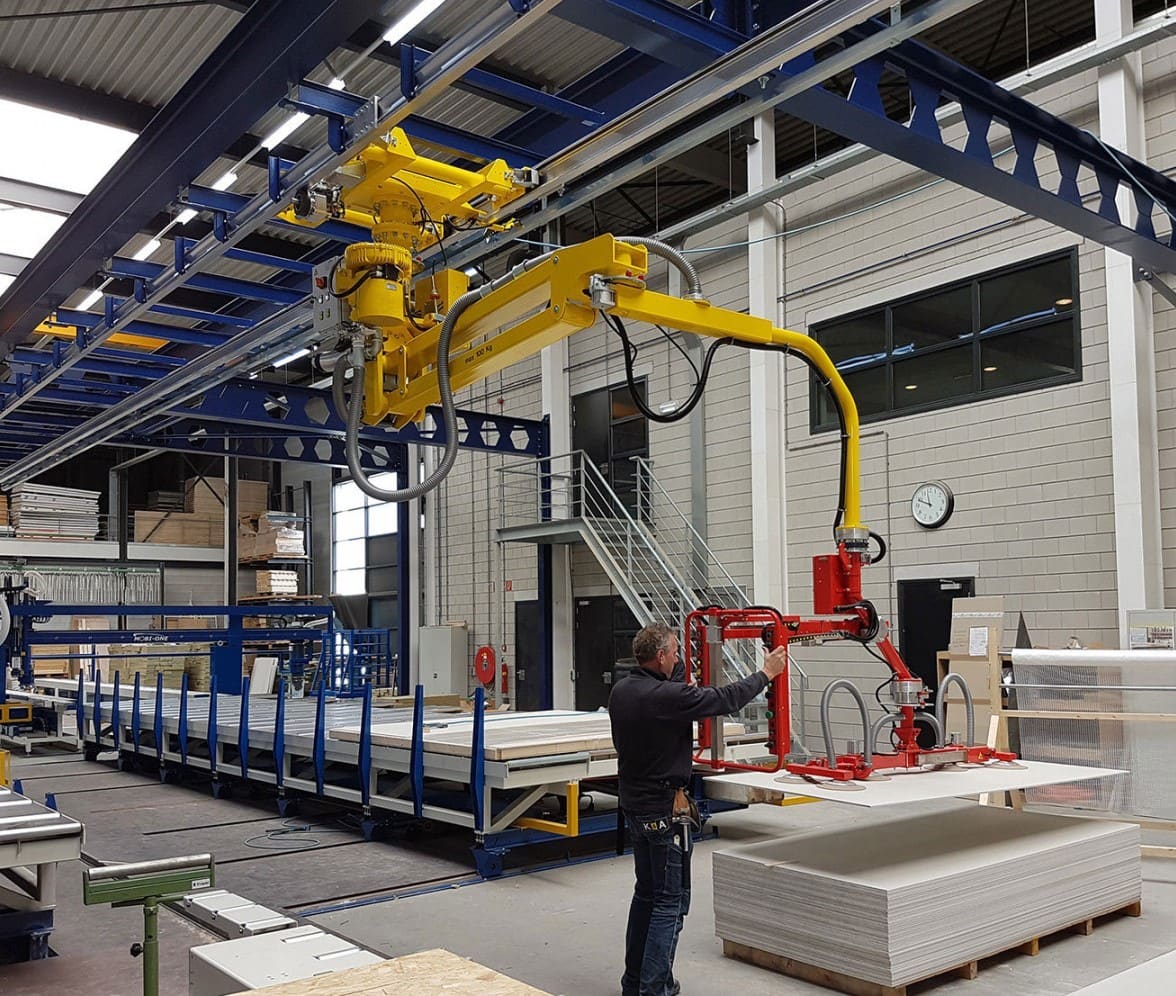
Stainless Steel Food Manipulator Lifting Ingredient Sack Processing Plant
FDA, USDA & HACCP Compliance: What Makes a Manipulator “Food Grade”?
This is where food manipulators differ most significantly from standard industrial manipulators, and it’s where specifying the wrong equipment can create serious regulatory problems.
Food-grade hygienic design is governed by several overlapping standards that your food-grade industrial manipulator must address:
Hygienic Material Requirements
- Stainless steel SS304/SS316: The industry standard for food contact surfaces. SS316 is preferred in high-chloride cleaning environments (common in dairy and seafood)
- FDA-approved elastomers: All seals, suction cups, and soft contact surfaces must use FDA-compliant rubber or silicone compounds
- No hollow sections: Hollow structural members can trap food residue and harbor bacteria; hygienic designs use sealed or solid sections throughout
Cleanability Standards
- IP65 minimum rating: Protects against water jets used in washdown cleaning
- EHEDG guidelines: European Hygienic Engineering & Design Group standards are increasingly adopted by North American food processors working with multinational buyers
- 3-A Sanitary Standards: Required by many dairy processors for equipment in direct contact zones
Regulatory Compliance
- USDA accepted equipment: For meat, poultry, and dairy applications, the USDA Agricultural Marketing Service maintains an accepted equipment list; your manipulator should meet these specifications
- HACCP compatibility: Equipment design should support your HACCP plan, specifically, it shouldn’t create Critical Control Point risks through design features that trap residue, accumulate moisture, or are difficult to inspect
Key Food Manipulator Applications by Production Environment
Food and beverage material handling requirements vary significantly by production type. Here’s where food manipulators make the biggest difference across specific environments:
Bulk Ingredient Handling — Sack Lifting Manipulators
Bakeries, flour mills, sugar refineries, coffee roasters, and grain processors all face the same challenge: moving hundreds of 25–50 kg ingredient bags per shift. A sack lifting manipulator for food production equipped with a bag gripper or vacuum lifter allows one operator to handle the full bag cycle, pick, carry, position, and discharge tip, without any manual lifting at all.
This single application alone is responsible for the majority of food industry MSD claims. One manipulator in a bulk ingredient area can effectively eliminate the most common injury source in your plant.
Drum and Barrel Handling
Drums of liquid ingredients, cooking oils, flavor syrups, vanilla extract, and wine concentrates routinely weigh 200–500 kg. A drum handling manipulator for food plants can lift, tilt, invert, and precisely pour drum contents into mixing vessels without spills, splashes, or the multi-person manual handling that these loads would otherwise require.
See how Thema’s solutions extend to brewery and distillery barrel handling →
Brewery and Beverage — Keg Handling
Filled beer kegs weigh 58–160 lbs. An operator handling kegs manually across a full shift accumulates enormous cumulative spinal loading. A brewery manipulator for keg handling eliminates the manual component, protecting the workers your craft operation depends on. Glass bottle lines present a different challenge: fragile, high-value product that can’t be dropped, vacuum-cup equipped beverage bottling line manipulators handle glass with the care and consistency that manual methods can’t guarantee.
Packaging and Palletizing
Food and beverage material handling equipment for packaging operations includes end-of-line manipulators for case handling, crate stacking, and pallet loading. These systems integrate with existing conveyor and palletizing infrastructure, providing the ergonomic bridge between automated conveyors and manual pallet truck operations.
See Thema’s pneumatic manipulators for packaging operations →
Dairy and Liquid Food Processing
Dairy environments demand the most from sanitary manipulator food processing designs, high-frequency hot water washdowns, caustic CIP (Clean-In-Place) chemical exposure, and zero tolerance for any residue accumulation. SS316 construction with IP65 or IP67 ratings is the minimum specification for manipulators used in direct dairy production areas.
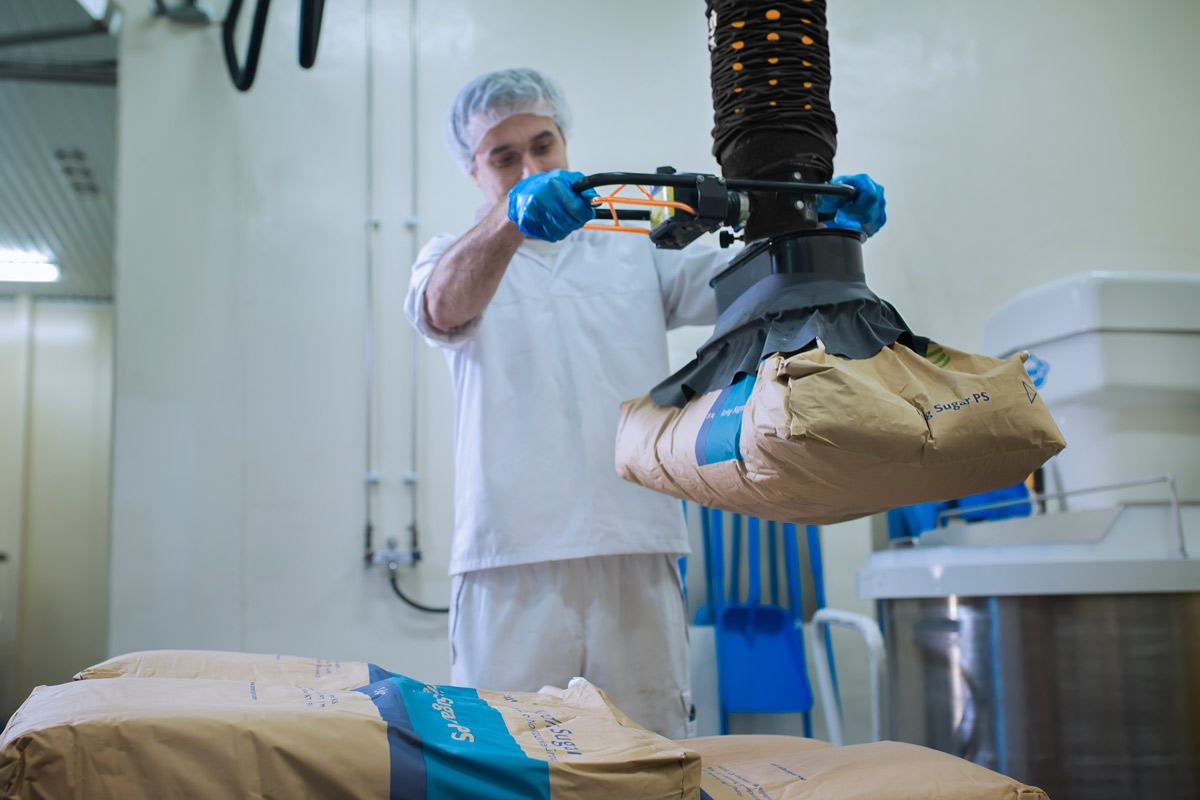
Food Grade Pneumatic Manipulator Drum Sack Handling Beverage Plant
Food Manipulator vs. Robot: What Your Production Line Actually Needs
The question comes up in every food plant capital planning discussion, and it deserves a clear, honest answer.
| Factor | Food Manipulator | Food Processing Robot |
| Control type | Human-guided | Fully automated |
| Best for | Variable loads, irregular products, and human judgment are required | Perfectly repetitive, structured, high-volume, identical tasks |
| Flexibility | Reconfigure the end-effector in hours | Reprogram in days |
| Hygiene compliance | Customizable to FDA/USDA spec | Varies widely by model |
| Load range | 10 kg – 500+ kg | Typically 3–100 kg for food robots |
| Initial cost | $$ | $–$$ |
| ROI timeline | 12–24 months | 24–48 months |
| Handles product variation | Yes, ideal for variable SKUs | Limited without vision systems |
| Seasonal demand flexibility | High | Low |
Robots handle the perfectly repetitive high-speed tasks, case sealing, label application, and palletizing uniform cases. Food manipulators handle the variable, judgment-dependent work, ingredient loading, drum handling, glass placement, and seasonal SKU changes.
Many Thema North America installations serve as the ergonomic bridge between manual receiving/ingredient prep areas and downstream automated production, a hybrid approach that captures the benefits of both technologies without the full capital commitment of end-to-end automation.
Choosing the Right Food Manipulator: 5 Questions for Your Facility
Before specifying any food-grade industrial manipulator, get clear answers to these five questions:
1. What is the heaviest load you need to handle, including packaging/tooling weight?
Spec for your maximum, not your average. A sack lifter rated for 50 kg won’t handle a 60-kg supersack edge case.
2. What is your cleaning protocol?
Washdown frequency, water temperature, cleaning chemical type (alkaline, acid, chlorinated), and pressure all determine the IP rating and material grade required. A facility running hot CIP cycles daily needs different specs than a dry ingredient handling area.
3. What does your production floor layout look like?
Ceiling height and floor space determine whether a floor-mounted column, overhead suspended, or mobile food manipulator configuration is most appropriate. Thema’s installation team conducts a full facility assessment before recommending any configuration.
4. How many different products or package types do you handle?
High SKU variability favors modular end-effector systems where the gripper or suction cup tooling can be swapped in minutes. Lower variety applications can use fixed tooling optimized for one product type.
5. Do you have specific regulatory requirements beyond the FDA/USDA baseline?
Organic certification, kosher or halal processing, export to EU markets (EHEDG compliance), or USDA-accepted equipment requirements all add specification constraints. These should be discussed upfront; contact the Thema North America team at the planning stage, not after equipment arrives.
Food Manipulator ROI: The Numbers That Get Capital Approved
Every capital equipment decision in food manufacturing ultimately comes down to one question: when does it pay for itself?
Typical ROI for food-grade industrial manipulators: 12–24 months.
| ROI Driver | Typical Annual Value |
|---|---|
| Reduced MSD workers’ comp claims | $15,000–$60,000/year |
| Lower EMR / insurance premium reduction | 15–35% premium reduction |
| Reduced product damage (dropped containers, torn sacks) | $5,000–$20,000/year |
| Labor efficiency (1 operator vs. 2–3) | $30,000–$60,000/year |
| Reduced FDA/USDA inspection risk from contamination incidents | Risk mitigation (uncapped value) |
| Throughput improvement | 15–30% cycle time reduction |
For a personalized ROI estimate, Thema’s application engineering team can walk through your specific application, injury history, and labor cost structure to build a business case for your capital committee.
Request a custom quote from Thema North America →
The Future: Smart Food Manipulators and Industry 4.0 in Food Processing
Industry 4.0 food manufacturing manipulators are moving beyond simple mechanical lifting; the next generation integrates digital intelligence:
IoT-Connected Predictive Maintenance: Modern food manipulator systems can report pressure trends, cycle counts, and wear indicators via IoT dashboards, giving maintenance teams alerts before failures happen. In a food plant running 500+ cycles per shift, unplanned downtime during a production run is a costly disruption. Predictive maintenance eliminates it. Thema’s maintenance program supports connected monitoring for long-term uptime protection.
AI-Assisted Load Sensing: Next-generation systems use AI-driven load-cell data to detect irregular weight distribution in real-time, automatically adjusting counterbalance for off-center or shifting loads like partially emptied drums or irregular ingredient bags.
Cobot Integration: As food plants adopt collaborative robots (cobots) for gentle product handling and inspection tasks, food manipulators are being integrated into shared human-cobot workstations, with the manipulator handling the weight while the cobot handles precision placement or inspection.
Digital Twin Integration: Leading food manufacturers are building digital twins of their production environments. Food-grade industrial manipulators with embedded sensors provide real-time data points that feed these digital models, enabling virtual line optimization before any physical changes are made.
Why Food & Beverage Manufacturers Choose Thema North America
We don’t send a catalog. We solve a handling problem.
Based in Harleysville, Pennsylvania, Thema North America serves food and beverage manufacturers across the United States, Canada, and Mexico. Our application engineering team has hands-on experience with the specific handling and hygiene challenges of food production, from bulk ingredient receiving to beverage bottling and dairy processing.
What food plant managers tell us matters most:
- Stainless steel hygienic construction meeting FDA/USDA/HACCP requirements
- IP65+ rated systems for washdown environments
- Custom end-of-arm tooling for your specific products and containers
- Professional on-site installation with minimal production disruption
- Structured maintenance program protecting your investment long-term
- CE-certified and ISO 9001-aligned systems
- North America-wide coverage with responsive support
Browse our full product range →
Ready to protect your workers and your product integrity with the right food manipulator? Contact our team today →
267-551-5517 | jen@thema-northamerica.com | 3800 Ashland Drive, Harleysville, PA 19438
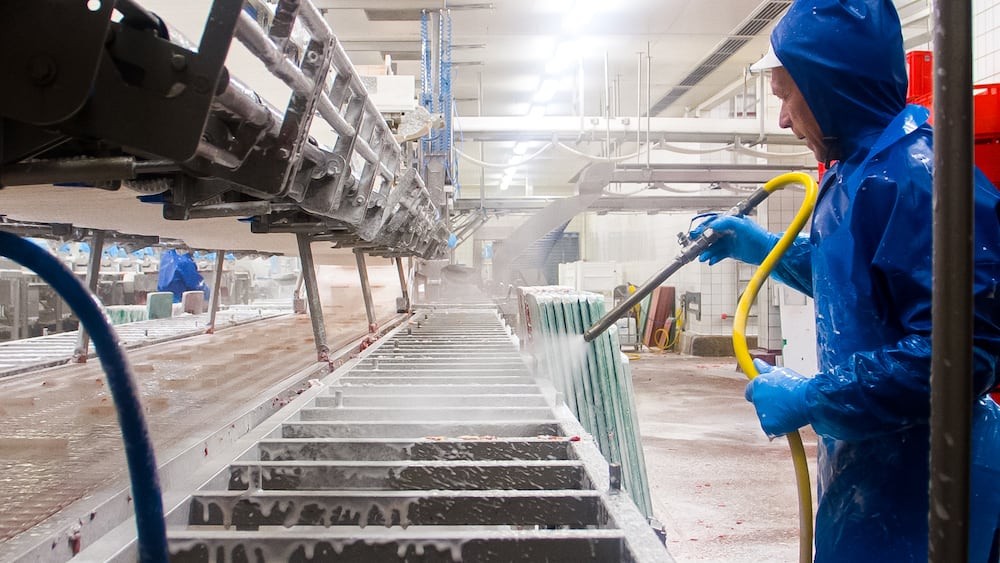
Thema North America Sanitary Food Manipulator Pennsylvania Production
FAQ: Food Manipulators — Questions Real Food Plant Managers Ask
1. What is a food manipulator?
A food manipulator is a specialized industrial lifting and positioning device designed for food and beverage manufacturing environments. It allows one operator to safely handle heavy loads, ingredient sacks, drums, bottles, kegs, and crates with full three-dimensional control while meeting FDA, USDA, and HACCP hygiene standards. Unlike standard industrial manipulators, food manipulators use stainless steel construction, food-safe end-effectors, and IP-rated sealed designs for washdown cleaning compatibility.
2. What is the difference between a food manipulator and a standard industrial manipulator?
The core lifting mechanics are similar, but a food-grade industrial manipulator adds: stainless steel (SS304/SS316) construction, electropolished or smooth surfaces that prevent bacterial harboring, food-safe rubber/silicone end-effectors, IP65 or higher water ingress protection for washdown cleaning, and design features that comply with FDA, USDA, HACCP, and EHEDG hygienic design standards. Standard industrial manipulators are not appropriate for food production areas where sanitation and contamination control are required.
3. What can food manipulators handle in a food and beverage plant?
Food manipulators handle: bulk ingredient sacks of flour, sugar, salt, and grains (25–50 kg); drums of oils, syrups, and flavor concentrates (50–500 kg); glass bottles, jars, and containers; beer kegs and wine barrels; finished product crates and cases; and supersacks/big bags at ingredient receiving. End-of-arm tooling, grippers, vacuum cups, clamps, and tilters are customized for each specific product type.
4. Are food manipulators FDA and USDA compliant?
Food-grade industrial manipulators can be built to meet FDA, USDA, and HACCP compliance requirements. Key compliance features include: food-safe stainless steel construction, FDA-approved contact materials, IP65+ washdown ratings, and a design that meets EHEDG and 3-A sanitary standards for applicable applications. Thema North America’s engineering team works directly with facility food safety managers to specify equipment that meets your plant’s specific regulatory requirements.
5. What is the ROI timeline for a food manipulator?
Most food manipulators achieve full return on investment within 12–24 months, driven by: reduced workers’ comp claims from eliminated manual lifting injuries, lower insurance premiums from improved EMR, reduced product damage (dropped containers, torn sacks), labor efficiency gains (one operator replacing two or three), and reduced contamination-related production losses. The OSHA Safety Pays tool can model the financial impact of preventing MSD claims for your specific operation.
6. How are food manipulators cleaned and sanitized?
Sanitary food manipulators are designed for complete washdown cleaning using high-pressure hot water, alkaline CIP chemicals, and sanitizing agents. IP65 or IP67 ratings ensure full protection of electrical and pneumatic components during cleaning. Smooth-ground stainless steel surfaces, sealed hollow sections, and crevice-free design eliminate bacterial harborage points. Cleaning protocols are documented and validated as part of the HACCP plan integration.
7. Can food manipulators handle glass bottles without breakage?
Yes. Beverage bottling line manipulators equipped with vacuum suction cup end-effectors handle glass bottles, jars, and containers with controlled, consistent grip force, preventing the fumbling and dropping that causes manual handling breakage. Vacuum systems can be configured for single-bottle precision placement or multi-bottle row handling depending on line requirements.
8. What is the difference between a food manipulator and a food handler?
A food manipulator is an industrial machine, a mechanical lifting and positioning device used in food manufacturing. A “food handler” is a person who works with food in preparation, service, or production. These are entirely different things. This page covers food manipulators (the equipment), not food handler job roles or certifications.
9. Do food manipulators work in dairy processing environments?
Yes, but dairy environments require the most demanding sanitary manipulator food processing specifications. High-frequency hot-water washdowns, caustic CIP chemical cycles, and zero-tolerance contamination standards mean dairy manipulators should use SS316 stainless steel (higher chloride resistance than SS304), IP65 or IP67 ratings, EHEDG-compliant design, and, in some cases, 3-A sanitary standard certification. Thema’s application engineers specify equipment to these exact requirements for dairy plant installations.
10. Where can food and beverage manufacturers in North America get food manipulators?
Thema North America, headquartered in Harleysville, Pennsylvania, supplies, engineers, and installs food-grade industrial manipulators for food and beverage manufacturers across the United States, Canada, and Mexico.
Contact our team at 267-551-5517 or jen@thema-northamerica.com for a free facility assessment and application-specific recommendation.
Request a quote →