

Thema North America: Precision Ergonomic Material Handling Solutions
The food industry confronted sobering recall statistics in 2024 that underscore how contamination events transform from production floor incidents into business-threatening crises. While total recall announcements decreased slightly from 2023, the severity of outcomes escalated dramatically. Hospitalizations from foodborne illness more than doubled, reaching 487 compared to 230 the prior year. Deaths climbed from 8 to 19. These statistics represent real people harmed by contaminated food—and real companies facing regulatory scrutiny, litigation exposure, and brand damage that may persist for years.
The concentration of illness cases reveals how quickly contamination events can escalate. According to the U.S. PIRG Education Fund’s Food for Thought 2025 report, 98 percent of the 1,392 confirmed foodborne illnesses in 2024 came from just 13 outbreaks. This concentration demonstrates that when contamination reaches consumers, consequences compound rapidly. Individual outbreaks sickened hundreds—the Salmonella outbreak linked to cucumbers caused 551 illnesses and 155 hospitalizations alone. The Listeria outbreak connected to deli meats resulted in 60 hospitalizations and 10 deaths across 19 states.
For food manufacturers, these statistics translate into existential business risk. Equipment decisions affecting contamination prevention deserve attention proportional to their potential consequences. Material handling systems operating within production environments either support sanitation programs or undermine them through design characteristics that complicate cleaning, harbor pathogens, or introduce foreign materials. Hygienic design principles established by organizations including 3-A Sanitary Standards and the European Hygienic Engineering and Design Group provide frameworks for equipment specification that contamination prevention demands.
Understanding How Contamination Reaches Consumers
Pathogen contamination—Listeria, Salmonella, and E. coli—drove 39 percent of all food recalls in 2024, an increase of 41 percent over the prior year. Listeria recalls increased from 47 to 65, while Salmonella recalls climbed from 27 to 41. These bacteria establish themselves in production environments through mechanisms that inadequate sanitation fails to interrupt. Once established, they can persist on surfaces, in biofilms, and within equipment crevices despite routine cleaning procedures.
Equipment design directly influences whether pathogens find harborage points enabling persistence. Surfaces with microscopic imperfections harbor bacteria that cleaning chemicals cannot reach. Crevices between components trap product residue providing nutrients for bacterial growth. Unsealed joints allow moisture penetration creating conditions favoring microbial proliferation. Equipment constructed without hygienic design principles becomes part of the contamination problem rather than part of the solution.
The 3-A Sanitary Standards organization maintains standards for equipment design addressing precisely these contamination vectors. Originating in dairy industry collaboration between sanitarians, equipment fabricators, and processors, 3-A standards specify material requirements, surface finish criteria, and construction principles that prevent bacterial harborage. Equipment bearing the 3-A symbol demonstrates compliance with standards that FDA and USDA reference in regulatory guidance. While 3-A certification remains voluntary, the standards represent industry consensus on hygienic design requirements that contamination prevention demands.
Material handling equipment operating within food zones falls within the scope of hygienic design requirements that processing equipment receives more attention for addressing. Vacuum lifters, manipulators, and positioning systems contact product packaging and may contact products directly depending on application. Their construction influences sanitation program effectiveness in ways that contamination prevention programs should address.
The Business Consequences of Contamination Events
Recalls impose direct costs including product retrieval, destruction, and replacement alongside notification expenses and regulatory response requirements. These quantifiable expenses, while substantial, understate total impact. Brand damage from high-profile recalls persists long after recalled products leave shelves. Consumer confidence once lost requires extended effort to rebuild. Retail relationships strained by supply disruptions may never fully recover.
The 2024 Boar’s Head Listeria outbreak illustrates consequence magnitude. The recall eventually encompassed more than 7 million pounds of ready-to-eat meat products. Ten deaths and 60 hospitalizations across 19 states generated sustained media coverage. Inspection reports revealing unsanitary conditions at the implicated facility intensified scrutiny. The company faces litigation, regulatory oversight, and reputation recovery challenges that will persist for years.
Smaller manufacturers face proportionally greater existential risk from major contamination events. Large companies possess resources to weather crisis response, litigation defense, and brand rehabilitation. Smaller operators may lack reserves to survive extended production shutdowns, regulatory consent agreements, and customer defections. For these facilities, contamination prevention through proper equipment and procedures represents existential risk management rather than mere cost optimization.
Examining broader workplace safety considerations affecting food manufacturing operations, Why Food Manufacturing’s Hidden Injury Costs Threaten Both Worker Safety and FSMA Compliance explores how worker protection and contamination prevention intersect in ways affecting both human resources and quality assurance.
Hygienic Design Principles for Material Handling Equipment
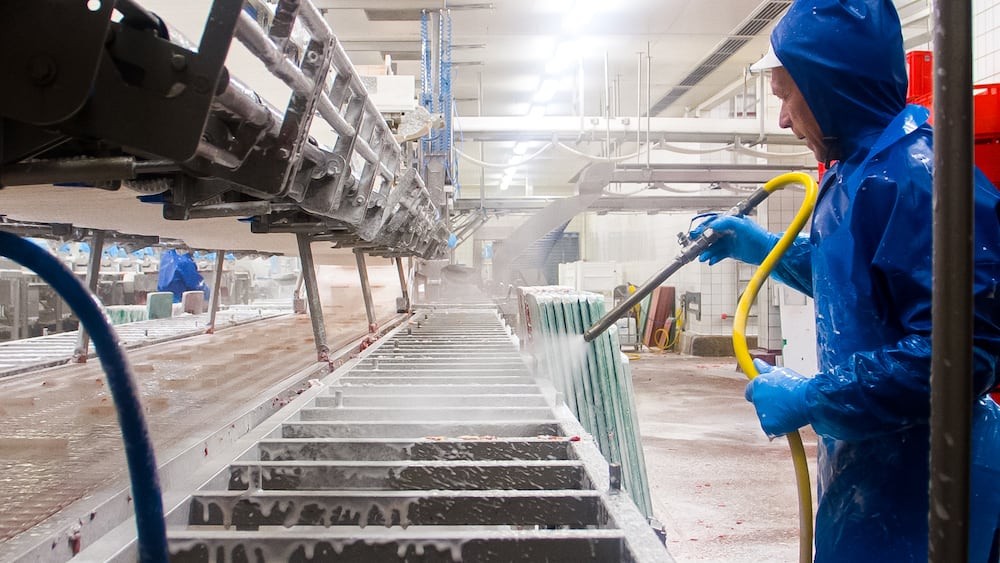
Food-grade material handling equipment incorporates design principles that industrial equivalents lack. Stainless steel construction using 304 or 316 grades provides corrosion resistance under repeated exposure to cleaning chemicals and sanitizers. Surface finishes meeting Ra 0.8 µm roughness specifications prevent bacterial accumulation in microscopic imperfections. Sealed construction eliminates gaps where product residue might collect between sanitation cycles. Sloped surfaces promote drainage rather than allowing standing water that supports microbial growth.
The vacuum gripping components contacting products or packaging require particular attention. Food-grade silicone or FDA-compliant elastomers provide suction while withstanding sanitation procedures. Quick-disconnect fittings enable cup replacement when wear compromises hygiene or performance. Smooth transitions between components eliminate ledges where residue might accumulate. These details distinguish equipment supporting sanitation programs from equipment complicating them.
Environmental considerations influence specification for food manufacturing zones. Refrigerated environments require materials and lubricants maintaining performance at temperatures compromising standard components. Wet processing areas demand moisture resistance throughout electrical and mechanical systems. Dusty environments involving flour or particulate ingredients need filtration protecting pneumatic systems from contamination affecting performance or maintenance requirements.
Understanding how equipment selection fits within broader food safety and productivity objectives, How Hygienic Vacuum Lifters Are Transforming Food Manufacturing Safety and Compliance provides context for equipment decisions affecting contamination prevention alongside worker protection.
Integrating Equipment Decisions with Food Safety Programs
FSMA requires covered facilities to develop food safety plans identifying hazards and establishing preventive controls minimizing those hazards. Equipment specifications fall within this framework when equipment characteristics affect contamination risk. Material handling systems constructed from inappropriate materials, featuring crevices that harbor bacteria, or resisting thorough cleaning represent hazards that food safety plans should address through equipment selection criteria.
Supplier qualification programs should evaluate material handling equipment providers against food safety criteria parallel to ingredient supplier evaluations. Documentation of food-grade materials, surface finish specifications, and construction standards demonstrates supplier commitment to hygienic design principles. Certification from recognized bodies including 3-A Sanitary Standards provides third-party validation of compliance with established standards. These qualification elements ensure equipment investments support rather than undermine food safety programs.
Ongoing sanitation validation should encompass material handling equipment within environmental monitoring programs. Swab testing surfaces that contact products or packaging detects contamination before it reaches consumers. ATP testing validates cleaning effectiveness following sanitation procedures. These monitoring activities identify equipment harboring persistent contamination that design characteristics or cleaning procedure modifications might address.
Thema North America: Your Partner in Hygienic Material Handling
Thema North America delivers vacuum lifting and pneumatic manipulator systems engineered for food manufacturing environments where contamination prevention determines business survival. Our sanitary designs incorporate food-grade materials, sealed construction, and smooth surfaces that support your food safety programs and protect your brand.
Our Services Include:
- Pneumatic Manipulators – Hygienic lifting systems constructed around sanitary design principles meeting food manufacturing requirements
- Custom Food-Grade Solutions – Equipment configured for your specific products, production environment, and sanitation protocols
Ready to Protect Your Products and Your Brand? Contact Thema North America for a comprehensive assessment of how hygienic material handling equipment can support your contamination prevention programs.
Works Cited
“Food for Thought 2025.” U.S. PIRG Education Fund, pirg.org/edfund/resources/food-for-thought-2025/. Accessed 30 Jan. 2026.
“3-A Sanitary Standards.” 3-A Sanitary Standards, Inc., www.3-a.org/. Accessed 30 Jan. 2026.
Related Articles
- How Hygienic Vacuum Lifters Are Transforming Food Manufacturing Safety and Compliance
- Why Food Manufacturing’s Hidden Injury Costs Threaten Both Worker Safety and FSMA Compliance