

Thema North America: Precision Ergonomic Material Handling Solutions
Food manufacturing sits at a critical intersection where worker safety, labor availability, and regulatory compliance collide with increasing force. The industry recorded a total recordable injury rate of 3.6 cases per 100 full-time equivalent workers in 2023, significantly higher than private industry overall. Meanwhile, 74,000 food manufacturing positions remained unfilled as of 2024, creating production bottlenecks that ripple through supply chains already strained by quality demands and consumer expectations. Into this challenging environment, hygienic vacuum lifting systems offer a solution addressing multiple pressure points simultaneously.
The Bureau of Labor Statistics tracks 1.77 million workers in food manufacturing across more than 42,000 establishments nationwide. These facilities transform livestock and agricultural products into the packaged foods consumers expect to find on store shelves. The physical nature of food processing—lifting heavy containers, transferring bulk ingredients, loading production equipment—creates ergonomic hazards that contribute to the industry’s elevated injury rates. Manual material handling tasks expose workers to strains, sprains, and musculoskeletal disorders that require medical treatment, restrict work activities, or force extended absences.
The consequences extend beyond worker welfare into operational performance and competitive positioning. Food manufacturers competing for scarce labor cannot afford reputations as dangerous workplaces. Production managers struggling to meet output targets cannot absorb the disruptions that injuries create. Quality assurance professionals focused on contamination prevention cannot ignore the cross-contamination risks that poorly designed manual handling introduces. Hygienic vacuum lifters engineered specifically for food environments address these interconnected challenges through equipment designed around both ergonomic and sanitation principles.
The Regulatory Framework Shaping Equipment Decisions
The FDA Food Safety Modernization Act fundamentally transformed how food manufacturers approach contamination prevention. FSMA shifted regulatory focus from responding to foodborne illness outbreaks toward preventing them through mandatory hazard analysis and risk-based preventive controls. The FDA’s Preventive Controls for Human Food rule requires covered facilities to implement written food safety plans identifying hazards and establishing controls to minimize or prevent those hazards from reaching consumers.
Sanitation controls constitute one category of preventive controls that facilities must establish under FSMA. These procedures, practices, and processes ensure facilities remain maintained in sanitary condition, minimizing hazards such as environmental pathogens and contamination from employees handling food. Material handling equipment operating within food production zones directly impacts sanitation program effectiveness. Equipment that harbors bacteria in crevices, resists thorough cleaning, or introduces foreign materials creates hazards that sanitation programs must address.
Hygienic design principles recognized by organizations including the European Hygienic Engineering and Design Group and 3-A Sanitary Standards inform equipment specifications that food manufacturers should prioritize. Surfaces contacting food products require materials that are non-toxic, non-absorbent, and resistant to corrosion. Stainless steel meeting food-grade specifications provides durability under repeated cleaning and sanitization cycles. Smooth surface finishes prevent bacterial accumulation in microscopic imperfections that cleaning chemicals cannot reach. Sealed construction eliminates gaps where product residue might collect between shifts.
Understanding the specific injury mechanisms affecting food processing workers helps manufacturers select equipment addressing their particular hazards. Exploring Why Food Manufacturing’s Hidden Injury Costs Threaten Both Worker Safety and FSMA Compliance reveals how ergonomic risks intersect with contamination prevention in ways that affect both human resources and quality assurance budgets.
Labor Market Realities Driving Automation Investment
Food manufacturing competes for workers against industries offering perceived advantages in schedule flexibility, physical demands, and workplace conditions. The sector’s traditional reliance on manual labor for tasks including lifting, transferring, and positioning heavy loads limits candidate pools to workers physically capable of sustained exertion. This capability requirement excludes potential employees who might excel at food processing tasks were physical strength barriers removed from job descriptions.
Labor costs in food manufacturing rose 7.5 percent in 2024 according to Federal Reserve tracking, reflecting competitive pressure to attract and retain workers despite an industry struggling to fill positions. Nearly 60 percent of manufacturers surveyed by the National Association of Manufacturers cited inability to attract and retain employees as their top challenge. This difficulty persists despite wage increases that compress margins already under pressure from ingredient costs and competitive pricing.
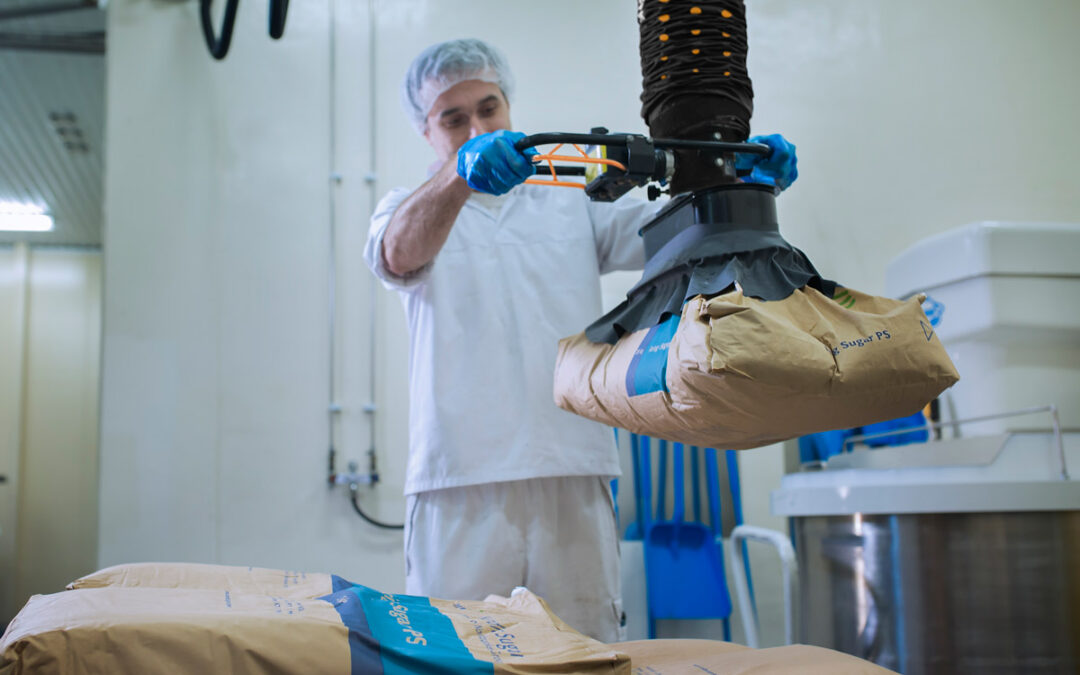
Vacuum lifting systems transform material handling from strength-dependent tasks into precision operations that workers across physical capabilities can perform consistently. Pneumatic systems generate lifting force through compressed air, rendering heavy loads essentially weightless at the point of operator contact. Workers guide loads through production processes rather than muscling them through movements that strain backs, shoulders, and joints. This mechanical advantage expands candidate pools while protecting existing workers from injuries that might end their employment.
The throughput benefits compound labor advantages. Workers freed from fatigue accumulation maintain consistent productivity across shifts rather than slowing as muscles tire. Training timelines compress when new hires need not develop strength and stamina before achieving full productivity. Cross-training becomes practical when physical capability differences between workers no longer determine who can perform specific tasks. These operational improvements generate returns that justify equipment investments independent of injury prevention benefits.
Contamination Prevention Through Equipment Design
Manual material handling introduces contamination vectors that hygienic vacuum systems eliminate or minimize. Workers lifting loads by hand may contact product surfaces with gloves, clothing, or skin that might carry pathogens or foreign materials. Hands gripping container edges create contact points requiring sanitation attention. Improper lifting techniques that drag containers across surfaces generate friction that can dislodge particles or create abrasion introducing physical contamination hazards.
Vacuum lifting eliminates most direct product contact during material transfer operations. Suction cups engineered from food-grade materials contact container or packaging surfaces in controlled zones that sanitation programs can address systematically. The lifting motion proceeds vertically without the dragging or sliding that manual handling often introduces. Operators guide loads through precise positioning rather than wrestling them into place through movements that might contact adjacent products or surfaces.
The sanitary design features distinguishing food-grade vacuum systems from industrial equivalents address cleaning requirements that food manufacturing demands. Smooth stainless steel surfaces shed product residue during washdown procedures. Sealed electrical components withstand the moisture exposure that sanitation protocols involve. Quick-disconnect fittings allow suction cups requiring frequent cleaning or replacement to be changed without tools. Cable routing prevents harborage points where bacteria might survive between sanitation cycles.
Examining how contamination risks translate into business consequences for food manufacturers, How Sanitary Material Handling Equipment Protects Food Manufacturers from Recall Risks details the regulatory, financial, and reputational stakes that equipment decisions affect.
Integration with Food Production Environments
Effective deployment of hygienic vacuum lifters requires thoughtful integration with existing production layouts and workflows. Ceiling-mounted systems provide lift assist without consuming floor space that production equipment and traffic lanes require. Rail systems extending along production lines enable single lift units to serve multiple workstations, maximizing equipment utilization while minimizing capital requirements. Freestanding units on casters provide flexibility for facilities with changing layouts or seasonal production variations.
The gripping systems matching vacuum lifters to specific products determine handling effectiveness across the diverse container types food manufacturing involves. Bag handling attachments secure flexible packaging that standard suction cups might deform. Box grippers provide stable holds on cardboard cases containing finished products. Custom tooling addresses specialized containers unique to particular product categories. Selecting appropriate gripping solutions for each application ensures reliable performance that workers trust and production schedules require.
Environmental factors including temperature, humidity, and airborne particulates influence equipment specification for food manufacturing zones. Refrigerated environments require materials and lubricants maintaining performance at temperatures that would compromise standard components. Wet processing areas demand moisture resistance throughout electrical and mechanical systems. Dusty environments involving flour, powders, or particulate ingredients need filtration protecting pneumatic systems from contamination that might degrade performance or introduce maintenance requirements.
Thema North America: Your Partner in Hygienic Material Handling
Thema North America delivers vacuum lifting and pneumatic manipulator systems engineered for food manufacturing environments where hygiene, safety, and productivity intersect. Our sanitary designs incorporate food-grade materials, sealed construction, and smooth surfaces that meet the demanding requirements of FSMA-compliant facilities.
Our Services Include:
- Pneumatic Manipulators – Hygienic lifting systems configured with food-grade grippers for your specific containers and products
- Custom Sanitary Solutions – Equipment engineered around your facility layout, product characteristics, and cleaning protocols
Ready to Transform Your Food Manufacturing Operations? Contact Thema North America for a comprehensive assessment of how hygienic vacuum lifting systems can protect your workforce while supporting your food safety programs.
Works Cited
“Food Manufacturing: NAICS 311.” Industries at a Glance, U.S. Bureau of Labor Statistics, www.bls.gov/iag/tgs/iag311.htm. Accessed 30 Jan. 2026.
“FSMA Final Rule for Preventive Controls for Human Food.” U.S. Food and Drug Administration, www.fda.gov/food/food-safety-modernization-act-fsma/fsma-final-rule-preventive-controls-human-food. Accessed 30 Jan. 2026.
Related Articles
- Why Food Manufacturing’s Hidden Injury Costs Threaten Both Worker Safety and FSMA Compliance
- How Sanitary Material Handling Equipment Protects Food Manufacturers from Recall Risks