
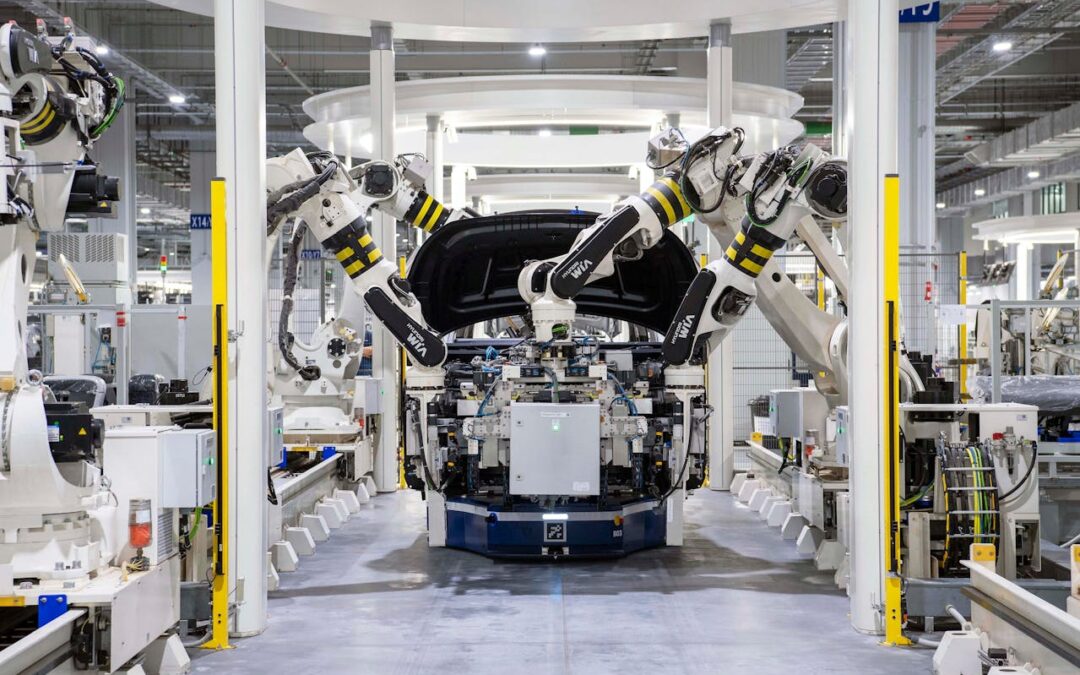
The electric vehicle manufacturing boom is cascading through automotive supply chains with requirements that extend far beyond component specifications. Original equipment manufacturers are increasingly mandating that suppliers demonstrate ergonomic handling capabilities as a condition of doing business. These requirements reflect OEM recognition that worker safety throughout the supply chain directly impacts component quality, delivery reliability, and ultimately vehicle safety. Integrating an industrial manipulator into production lines has become a standard requirement for suppliers aiming to stay competitive.
The International Automotive Task Force maintains customer-specific requirements from major OEMs including Ford, General Motors, Stellantis, Toyota, and Honda. These requirements, which suppliers must meet for IATF 16949 certification, increasingly address workplace safety and ergonomic considerations alongside traditional quality metrics. Pneumatic manipulators for automotive manufacturing offer a proven pathway to meeting these rigorous standards while maintaining high production volumes.
The Automotive Industry Action Group has developed packaging and containerization guidelines specifically addressing ergonomic concerns in material handling. According to AIAG documentation, current packaging practices represent both ergonomic concerns and major expenses for automotive manufacturers and suppliers. These guidelines establish common approaches to container design based on ergonomic principles accounting for manual tasks including pushing, pulling, lifting, lowering, and carrying. Suppliers implementing AIAG-compliant handling solutions position themselves favorably for OEM qualification while protecting their own workforce.
Key Takeaways
- OEMs increasingly impose customer-specific ergonomic requirements, often tied to IATF 16949 quality standards, on their supplier base.
- EV component suppliers face heavier parts than legacy internal-combustion production, raising manual-handling risk.
- Pneumatic manipulators help suppliers meet OEM ergonomic compliance requirements directly.
- Suppliers need audit-ready documentation demonstrating ergonomic risk controls are in place.
- Safety investment is becoming a competitive differentiator in winning and retaining OEM contracts.
Customer-Specific Requirements Driving Equipment Investment
Major automotive OEMs maintain detailed supplier requirements that extend beyond traditional quality management. Ford, General Motors, and Stellantis each publish customer-specific requirements that IATF-certified suppliers must meet. These documents increasingly reference worker safety expectations that implicitly require ergonomic handling solutions for heavy components.
The supply chain dynamics of EV production intensify these requirements. Battery components, electric motors, and power electronics all present handling challenges exceeding traditional automotive parts. Suppliers manufacturing these components face the same ergonomic challenges as OEM assembly plants, but often with less capital to invest in solutions. OEMs recognize that supplier injuries can disrupt component supply and compromise quality.
Tier 1 suppliers face particular pressure because they must meet OEM requirements while simultaneously managing their own supplier networks. The requirement cascade means that ergonomic handling expectations flow from OEMs to Tier 1 suppliers and ultimately to Tier 2 and Tier 3 operations. Understanding the investment patterns driving these requirements, as detailed in [North America’s $250 Billion EV Battery Plant Boom Creates Unprecedented Material Handling Demand], helps suppliers anticipate capability requirements before customer audits reveal gaps.
Quality management system audits increasingly examine workplace safety metrics alongside traditional quality indicators. Suppliers with high injury rates face questions about process control and management system effectiveness. Demonstrating ergonomic handling solutions provides objective evidence of systematic approaches to workplace safety that auditors recognize as indicators of broader operational excellence.

The Weight Reality Facing EV Component Suppliers
Electric vehicle components present weight challenges throughout the supply chain. Battery modules shipped to OEM assembly plants must be handled at supplier facilities during manufacturing, testing, and packaging operations. Electric motor assemblies, inverters, and thermal management components all exceed weights that workers can safely handle manually.
The Bureau of Labor Statistics reported that manufacturing experienced 355,800 recordable injuries and illnesses in 2023. Musculoskeletal disorders from overexertion and repetitive motion represent a significant portion of these cases. Suppliers handling EV components without proper equipment face elevated injury risks that translate to workers’ compensation costs, productivity losses, and potential customer qualification issues.
NIOSH recommends a maximum lifting limit of 51 pounds under ideal conditions, with this limit reduced when lifting frequency increases, horizontal reach extends, or awkward positioning is required. Battery modules and motor assemblies frequently exceed these limits, which is why pneumatic manipulators for mechanical engineering are becoming essential for safety and precision.
The economic calculus favors equipment investment. National Safety Council data indicates the average cost per medically consulted workplace injury reached $43,000 in 2023. A single prevented injury can justify significant equipment expenditure, while multiple injuries can devastate small supplier operations through direct costs and insurance premium increases.
Pneumatic Manipulators as Compliance Solutions
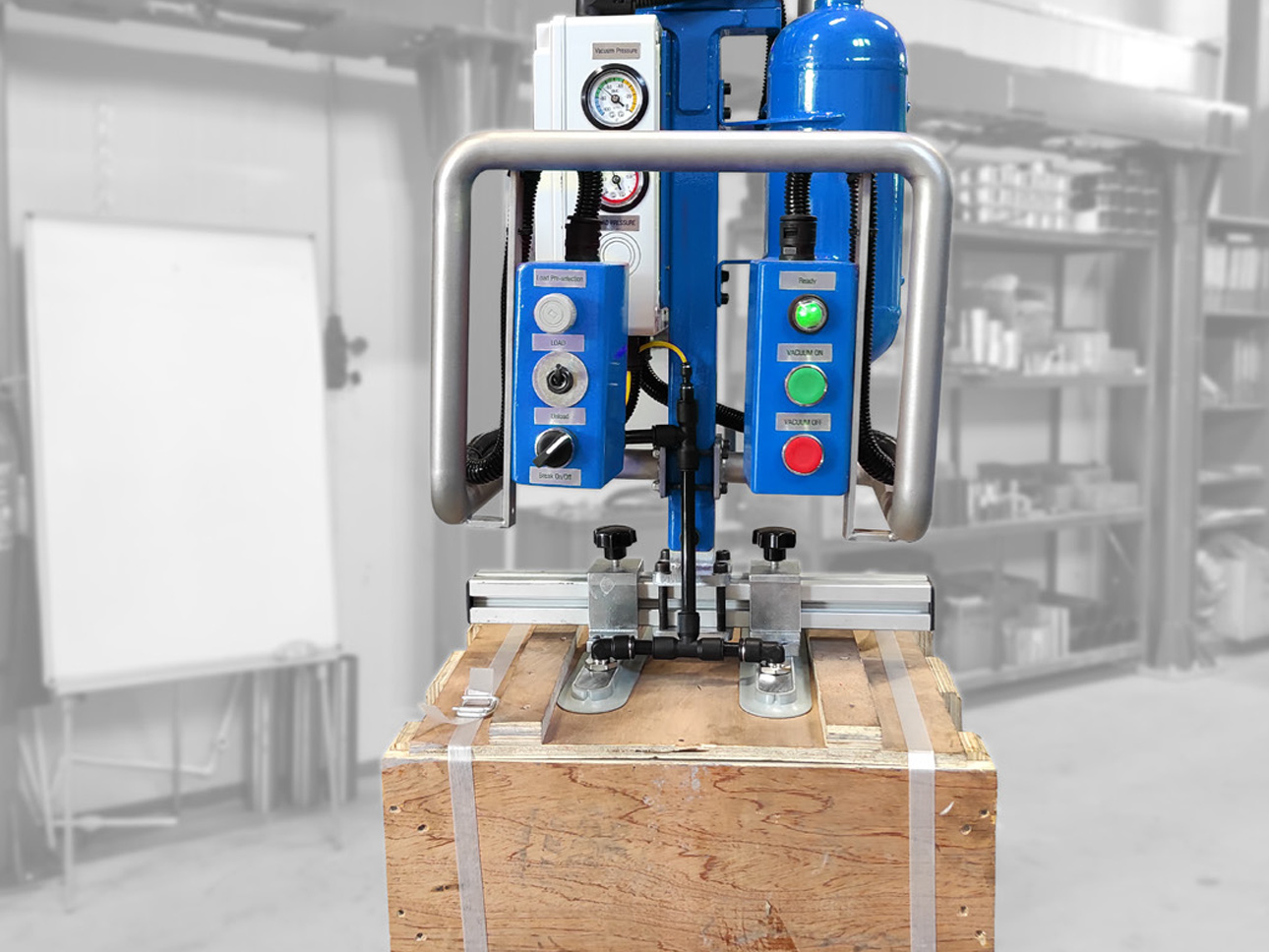
Pneumatic manipulator systems provide suppliers with cost-effective solutions meeting both ergonomic requirements and production needs. These systems counterbalance component weight using compressed air, enabling workers to handle heavy parts with minimal physical effort while maintaining the positioning precision that quality requirements demand.
Unlike automated solutions requiring substantial capital investment and programming expertise, pneumatic manipulators leverage existing workforce skills. Workers guide components naturally while the pneumatic system handles gravitational loads. Training requirements measure in hours rather than weeks, enabling rapid deployment without production disruption.
The technology scales across supplier operations of varying sizes. Small suppliers handling modest production volumes can implement single workstation solutions at accessible price points. Larger operations requiring multiple handling stations can standardize on common platforms, simplifying maintenance and training. This scalability makes pneumatic manipulators accessible to suppliers throughout the tiered supply chain structure.
Quality benefits complement ergonomic advantages. Components handled with pneumatic manipulators experience controlled movement without drops or impacts. This protection proves particularly valuable for sensitive EV components where handling damage may not become apparent until downstream testing or field operation. Suppliers demonstrating damage-free handling strengthen their position in customer quality reviews.
Audit Preparation and Documentation Requirements
Supplier audits increasingly examine ergonomic handling practices as indicators of management system maturity. Auditors assess whether suppliers have identified manual handling hazards, implemented appropriate controls, and documented their approaches. Suppliers lacking formal ergonomic programs face findings that can impact certification status or customer qualification.
Documentation requirements extend beyond equipment installation to encompass risk assessments, training records, and effectiveness monitoring. Suppliers must demonstrate systematic approaches to identifying handling hazards, selecting appropriate controls, training workers on proper techniques, and verifying that controls remain effective over time. This documentation burden favors standardized solutions with established training curricula and maintenance procedures.
The connection between ergonomic handling and product quality strengthens audit narratives. Suppliers explaining how pneumatic manipulators prevent both worker injuries and component damage demonstrate integrated thinking that auditors recognize as characteristic of mature quality management systems. This narrative coherence supports favorable audit outcomes.
Exploring how specific handling technologies address these requirements, as examined in [Zero-Gravity Lifting Technology Addresses EV Battery Assembly’s Ergonomic Crisis], provides suppliers with technical understanding supporting equipment selection and audit documentation. Suppliers demonstrating knowledge of available solutions signal commitment to continuous improvement.
Competitive Positioning Through Safety Investment
Suppliers investing in ergonomic handling equipment gain competitive advantages beyond compliance. Worker retention improves when employees recognize employer commitment to their physical wellbeing. Recruiting becomes easier when facilities can demonstrate safe working conditions. These workforce benefits compound over time as competitors struggle with turnover and staffing challenges.
Customer relationships strengthen when suppliers proactively address safety requirements rather than responding reactively to audit findings. OEM purchasing organizations increasingly evaluate suppliers on total capability rather than price alone. Suppliers demonstrating systematic approaches to worker safety signal operational maturity that purchasing teams value when selecting long-term partners.
Insurance costs reflect safety investment over time. Suppliers with strong safety records and documented hazard controls negotiate favorable workers’ compensation rates. These savings compound annually, potentially offsetting equipment investment costs within several years while providing ongoing competitive advantage.
The EV transition timeline creates urgency for suppliers evaluating equipment investments. Thema North America specializes in pneumatic manipulator systems engineered specifically for the automotive supply chain, ensuring you are ready for the next OEM audit
Thema North America: Your Partner in Supplier Excellence
Thema North America specializes in pneumatic manipulator systems engineered for automotive supplier requirements. Our Italian-designed equipment combines decades of ergonomic engineering expertise with solutions specifically configured for EV component handling challenges facing suppliers throughout the automotive supply chain.
Our Services Include:
- Pneumatic Manipulators for Automotive Manufacturing – Zero-gravity lifting solutions handling loads from 60 kg to 1,850 kg (4,078 lbs) with precision positioning and safety compliance.
- Custom End Effector Design – Application-specific tooling engineered for your component geometries and production requirements
Ready to Strengthen Your Customer Qualification? Contact Thema North America to discuss how pneumatic manipulator technology can support your audit preparation and operational excellence objectives.
Frequently Asked Questions
Why are automotive OEMs starting to require ergonomic equipment for supplier qualification?
IATF 16949 certification — the quality management standard automotive suppliers must hold to sell to OEMs — increasingly ties ergonomic risk controls to audit requirements, especially as EV components like battery packs and larger body panels push manual handling past safe limits.
What’s the maximum weight NIOSH recommends lifting manually?
51 pounds under ideal conditions — a limit that’s easy to exceed with EV components like battery modules and larger body panels, which is where mechanical lift assistance becomes necessary rather than optional.
How much does the average workplace injury cost automotive manufacturers?
The National Safety Council put the average cost of a medically consulted workplace injury at $43,000 in 2023, on top of 355,800 recordable manufacturing injuries and illnesses that year (BLS).
Can these systems be customized for EV-specific components?
Yes — custom end-effector (gripper) design is available to handle irregular or heavy EV components such as battery packs and body panels, with capacities up to 1,850 kg (4,078 lbs).
Works Cited
“AIAG Manual and Guidelines.” Automotive Industry Action Group, www.aiag.org/training-and-resources/manuals. Accessed 16 Dec. 2025.
“Customer Specific Requirements.” International Automotive Task Force, www.iatfglobaloversight.org/oem-requirements/customer-specific-requirements/. Accessed 16 Dec. 2025.
Related Articles
- [North America’s $250 Billion EV Battery Plant Boom Creates Unprecedented Material Handling Demand]
- [Zero-Gravity Lifting Technology Addresses EV Battery Assembly’s Ergonomic Crisis]