
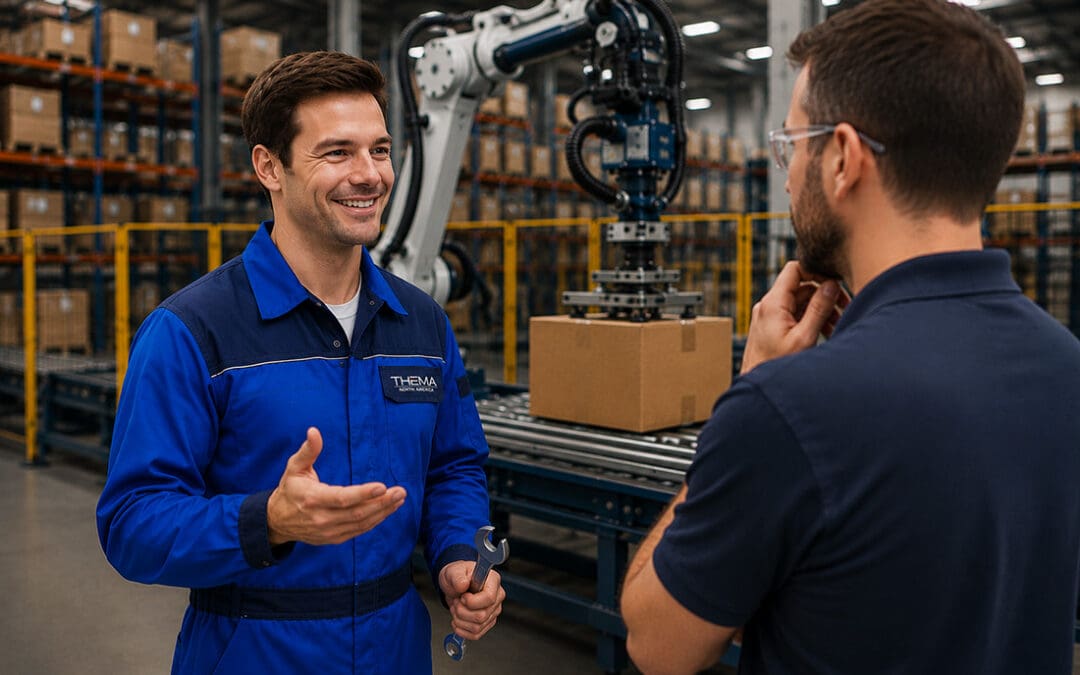
Short answer: A pneumatic manipulator is usually a strong fit in automotive assembly when the job combines a heavy or awkward part, repeated cycles, controlled placement, and a need for human-guided positioning rather than fully fixed automation. Typical candidates include doors, body panels, windshields, seats, dashboard assemblies, and some powertrain or battery-handling tasks. If the lift is infrequent, the part has no stable grip strategy, or the motion is completely fixed, another handling method may be the better choice.
What makes an automotive task a good fit for a pneumatic manipulator?
The first screen is not part weight alone. In the NIOSH Applications Manual for the Revised NIOSH Lifting Equation, lifting risk is shaped by horizontal reach, vertical lift origin, vertical travel distance, asymmetry, frequency, and coupling quality. The OSHA Technical Manual on back disorders and injuries also points to repetitive lifting, bending, twisting, awkward items, and forceful movement as important risk factors. For an automotive buyer, that means a pneumatic manipulator becomes more compelling when the operator is not just lifting a part, but lifting it often, at reach, with limited clearance, and then placing it accurately.
THEMA North America’s automotive manufacturing page highlights common applications such as vehicle doors, dashboard assemblies, engine components, body panels, seats, and windshields. Those examples have one thing in common: they are difficult to handle manually without combining load, reach, orientation control, and product-protection concerns.
- The part is large enough to block sight lines or force awkward hand positions.
- The task repeats across a shift, so fatigue and cumulative strain matter.
- The operator must guide the part into a fixture, body opening, rack, or assembly position with care.
- The load needs controlled rotation, tilt, or steady holding during placement.
- The part surface or geometry calls for task-specific tooling rather than a generic hook or hoist.
If several of those conditions are true at once, the application is usually worth a manipulator review.
Which automotive assembly tasks usually qualify?
1. Doors, hoods, fenders, and other body panels
Large panels are classic candidates because the problem is not only mass. The operator often has to protect painted or finished surfaces, move around obstructions, and align the part precisely without edge damage. That makes body panels a better fit for a human-guided manipulator than for a simple lift-only device. If the panel geometry is stable and the pick points are known, pneumatic tooling can make these tasks much more controllable.
2. Windshields and other glass-handling steps
Glass tasks often combine fragility, awkward reach, and placement accuracy. A manipulator can be a strong fit when the goal is to let the operator guide the glass while the equipment carries the load and stabilizes the motion. This is especially useful when the part must move through a narrow approach path or be seated carefully into a defined location instead of simply transferred from one pallet to another.
3. Seats, dashboards, and bulky interior modules
Interior assemblies are often less extreme in weight than powertrain components, but they can be harder to place cleanly because of size, visibility, and cabin access. These tasks become good manipulator candidates when operators must bend, reach into the vehicle, or twist while controlling a bulky part. A pneumatic manipulator helps most when the work requires fine positioning without asking the operator to carry the load at arm’s length.
4. Engine, transmission, and subassembly handling
Powertrain tasks are strong candidates when one operator needs to guide a dense part into a repeatable position, especially if the route includes lift, rotation, and careful descent. The right question is whether the operator still needs judgment and tactile control during placement. If yes, a human-guided manipulator may fit better than a fully automatic approach. If the motion is identical every cycle and the part presentation is tightly controlled, more automated equipment may deserve consideration.
5. Selected EV battery and heavy-module applications
Battery-related handling can also fit, but only after careful scoping. The application may involve high part value, strict placement tolerances, sensitive surfaces, and a larger consequence for contact errors. That does not rule out pneumatic manipulation. It means buyers should be more disciplined about confirming load geometry, grip method, path constraints, and required orientation control before choosing tooling or mounting.
When is a pneumatic manipulator probably not the best answer?
Not every automotive lift needs one. A pneumatic manipulator may be the wrong first move when the task is low-frequency, when the part has no reliable contact surfaces for safe tooling, or when the real bottleneck is upstream presentation rather than the lift itself. It can also be the wrong fit if the motion is fully fixed, the part always arrives in the same orientation, and no operator judgment is needed during placement. In those cases, a conveyor change, fixture redesign, crane, robot, or other workflow change may create more value.
This is why THEMA’s recent guide on scoping a pneumatic manipulator application is useful for buyers. It recommends documenting actual load weight range, part geometry, pickup points, required orientations, travel path, cycle rate, and environmental constraints before jumping to a model or quote. That is especially important in automotive work, where small changes in part presentation or orientation can change the best handling method.
What should you document before contacting a supplier?
If you want a useful first conversation, send application facts instead of a general request for a lifting solution. THEMA’s scoping guidance and product pages suggest collecting the information below before you ask for a recommendation.
- Actual part weight range, including any tooling or carriers the manipulator must handle.
- Part dimensions, center-of-gravity behavior, and acceptable contact surfaces.
- Required pick and place heights, horizontal reach, and any needed tilt or rotation.
- Cycle rate per hour or per shift, not just whether the task happens daily.
- Obstructions, guarding, rack geometry, or vehicle-access constraints that affect the motion path.
- Any product-protection concerns such as painted surfaces, glass, or sensitive assemblies.
- Operator needs, including one-handed guidance, visibility limitations, or multi-operator use across shifts.
That information helps separate three different decisions: whether the task truly fits a manipulator, what tooling style fits the part, and what mounting or layout approach fits the cell. It also makes it easier to connect the application to THEMA’s broader pneumatic manipulator portfolio instead of forcing a recommendation from incomplete data.
Bottom line
The best automotive manipulator applications usually sit in the middle ground between manual lifting and full automation. They involve repeated handling of large, awkward, or placement-sensitive parts where the operator still needs control, but should not be carrying the load. If a station involves doors, glass, interior modules, body panels, or dense subassemblies that are awkward to lift and exact to place, a pneumatic manipulator is often worth evaluating. If you can define the load, motion, and operator constraints clearly, you can get to a better recommendation much faster.
Sources
- THEMA North America: Pneumatic Manipulators for Automotive Manufacturing
- THEMA North America: Pneumatic Manipulators
- THEMA North America: How to Scope a Pneumatic Manipulator Application Before You Request a Quote
- NIOSH: Applications Manual for the Revised NIOSH Lifting Equation
- OSHA Technical Manual: Back Disorders and Injuries