
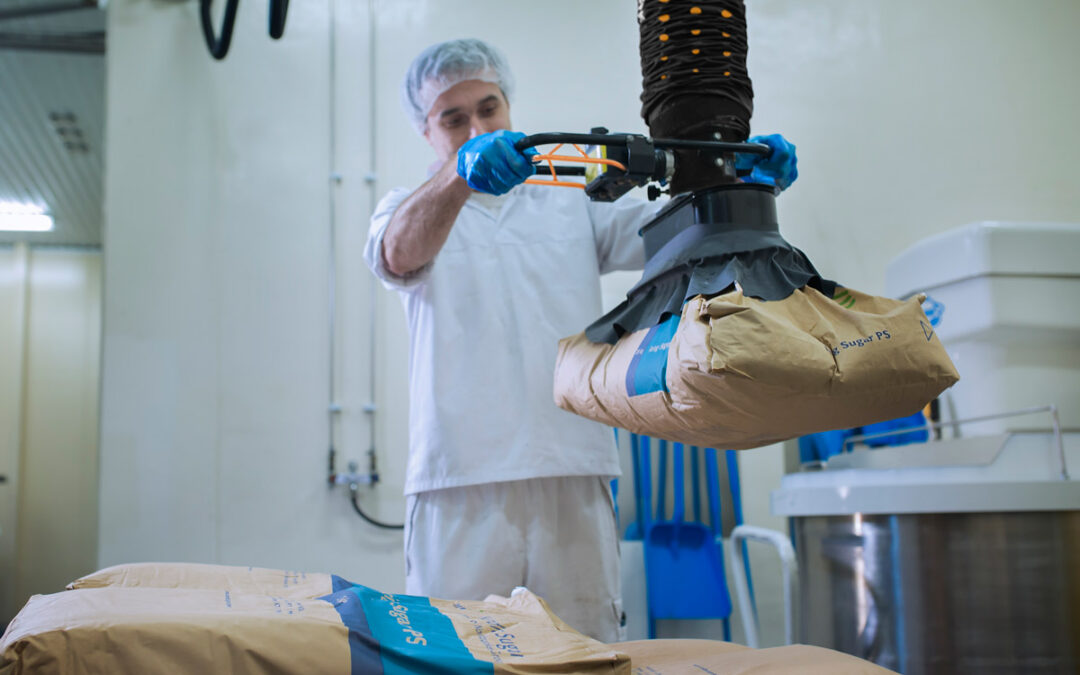
Before you buy a manipulator or redesign a workstation, prioritize the lifting tasks with the highest combination of force, awkward posture, repetition, and workflow disruption. A good ergonomic assessment does not treat every lift the same. It ranks the jobs most likely to slow production, strain operators, or require engineered assistance, then captures the application details needed to decide whether you need workstation changes, lift assist equipment, or a broader process review.
Why task prioritization matters before equipment selection
Industrial buyers usually do not need another generic list of ergonomic risks. They need to know which jobs deserve engineering attention first. That matters because the wrong starting point can send a team into solution shopping before it understands the real handling problem.
THEMA’s Practical Workflow Optimization Assessment is positioned to identify workflow inefficiencies, ergonomic risks, material handling challenges, and bottlenecks. THEMA’s Automation Readiness Assessment is designed to evaluate whether workflows, material handling, labor, and production processes are ready for automation. Those first-party assessment pages support a practical point: task selection should connect ergonomics to workflow and implementation, not just to discomfort reporting.
OSHA’s Ergonomics guidance says employers should look for risk factors such as forceful exertions, awkward postures, repetition, vibration, and contact stress. For an industrial buyer, those factors become a useful screening framework when you are deciding which lifts should move to the top of the assessment list.
Which manual lifting tasks should you assess first?
Start with the lifts that combine operator strain with business consequences. In most plants, the first tasks worth deeper analysis are the ones that have several of these characteristics at the same time:
- High hand force or heavy part presentation
- Shoulder-height picks, low picks near the floor, or extended horizontal reach
- Frequent cycles across a full shift rather than occasional handling
- Twisting, offset placement, or poor part orientation at pickup or setdown
- Operator dependency, where only a few experienced people can do the task well
- Downstream effects such as damaged product, slowed cycle time, or blocked flow
That last point is easy to miss. A lift can be moderate in weight and still deserve priority if it creates hesitation, awkward re-grips, or waiting at the next station. In other words, the best ergonomic assessment candidates are often the lifts that combine human risk with throughput risk.
What data should you capture for each prioritized task?
Once a task moves into the priority set, gather the details that will later shape solution design. Buyers should document more than part weight alone. At a minimum, record the pickup and drop-off heights, horizontal reach, vertical travel, task frequency, required orientation control, part stability, and whether the operator must position the load precisely at the end of the move.
It is also useful to note what changes from one cycle to the next. Does the part size vary? Is the center of gravity consistent? Are there space constraints, obstructions, conveyors, racks, or fixtures that limit access? Will the operator need to rotate, tilt, or hold the part while fastening or inspecting it? Those details often determine whether a standard lift assist, custom end-of-arm tooling, or a broader workflow change is the better next step.
If your team is already evaluating assistive equipment, THEMA’s pneumatic manipulators page frames the commercial goal clearly: safer industrial material handling with ergonomic, zero-gravity lifting. An assessment is what translates that general capability into an application-specific decision.
When is the NIOSH lifting equation useful—and when is it not?
The National Institute for Occupational Safety and Health explains in its Applications Manual for the Revised NIOSH Lifting Equation that the method is intended for evaluating certain two-handed manual lifting and lowering tasks under defined conditions. That makes it a useful screening tool for some plant lifts, especially when you need a more disciplined way to compare jobs.
It is not a universal answer. The NIOSH method does not replace application review for lifts that involve one-handed handling, unstable loads, carrying over distance, pushing or pulling, high-speed variability, seated or kneeling postures, or significant environmental complications. For buyers, the lesson is simple: use formal ergonomic methods where they fit, but do not let a narrow calculation stand in for a full application assessment.
How should buyers rank one task ahead of another?
A practical ranking model is to score each task on two dimensions: ergonomic exposure and operational impact. Ergonomic exposure covers force, posture, repetition, and control difficulty. Operational impact covers downtime risk, staffing difficulty, quality effects, and whether the lift constrains the rest of the line. The highest-priority projects are the tasks that score high on both dimensions.
This approach also helps buyers avoid premature solution bias. If a task is high in exposure but low in business impact, a workstation adjustment may be enough. If it is high in both, it may justify a more complete workflow review and a material handling solution designed around the real part path, operator motion, and process requirements.
What should happen after the assessment shortlist is built?
After you identify the top tasks, move quickly from screening to application definition. Confirm the load characteristics, path of travel, end-of-arm requirements, mounting constraints, operator interaction, and uptime expectations. Then decide whether you need a focused equipment discussion or a broader assessment of workflow and automation readiness.
For teams that are still sorting through multiple bottlenecks, THEMA’s Practical Workflow Optimization Assessment and Automation Readiness Assessment offer a more structured starting point than jumping straight to product selection. That is especially true when the lifting problem is tied to labor availability, line balancing, or inconsistent material presentation rather than weight alone.