
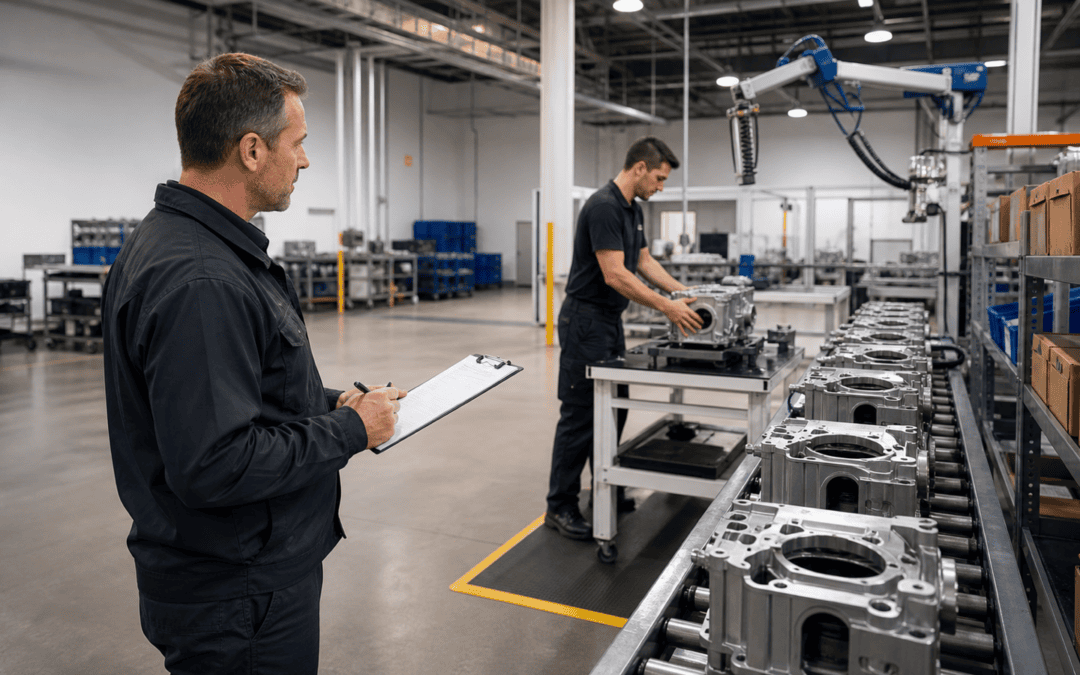
Manual handling becomes a throughput bottleneck when operators spend more time stabilizing, lifting, regripping, or waiting on a difficult load than advancing the process. If a task relies on two-person coordination, awkward reaches, repeated twisting, or one experienced operator who must keep bailing out the line, the constraint is usually the handling method itself. The right response is to measure the task, compare it with accepted ergonomic risk factors, and decide whether workflow redesign or lift assistance will remove the constraint.
When does manual handling become a throughput bottleneck?
Industrial buyers often notice the symptom before they name the cause: a cell keeps missing pace even when staffing and scheduling have already been adjusted. In many cases, the problem is not labor availability alone. It is that one lift, rotation, or transfer step is absorbing too much time, attention, and physical effort.
Common signals include:
- two-person lifts inside an otherwise one-person process;
- operators waiting for help before the next cycle can begin;
- repeated regrips because the load is awkward or hard to control;
- twisting, extended reaches, or floor-level picks that slow placement; and
- temporary workarounds such as staging parts on the floor or using carts as makeshift buffers.
Those signs matter because throughput losses and ergonomic risk often show up together. A difficult lift slows the operator, invites workarounds, and makes the process more dependent on individual strength and experience.
Another clue is workaround behavior: temporary carts appear, operators stage parts on the floor, or supervisors step in to help during peaks. Those are not just training problems. They are evidence that the process needs a different handling method or a better sequence of work.
What should you measure before changing equipment or layout?
Before buying a manipulator, conveyor, or fixture, measure the task itself. THEMA’s Practical Workflow Optimization Assessment is built around workflow observation, material flow analysis, ergonomic risk identification, bottleneck identification, and improvement recommendations. That sequence is useful because it keeps teams from treating every delay as an equipment problem.
For one representative task, record load weight and dimensions, pick and place heights, horizontal reach, need to twist or offset, lifts per hour, seconds spent aligning the load, regrips, queueing before and after the task, and whether the operation requires precision placement or simply transport.
Measure the task, not the story
A line may sound understaffed, but the better question is what the operator is physically doing each cycle. If the load is light but bulky, the bottleneck may be control and visibility. If the load is moderate but frequent, repetition may be the issue. If the operator must leave another task to help with a lift, the hidden cost is lost attention elsewhere in the process.
How do NIOSH and OSHA help you prioritize the right task?
The Revised NIOSH Lifting Equation gives buyers a structured way to judge whether a lift is acceptable for repeated work. The method considers horizontal reach, vertical location, vertical travel distance, asymmetry, frequency, and coupling when calculating a Recommended Weight Limit and a Lifting Index NIOSH Applications Manual. When the job demands poor hand positions, long reaches, twisting, or frequent lifts, the acceptable load drops quickly.
OSHA’s ergonomics guidance also points buyers to recurring risk factors such as force, awkward postures, repetition, vibration, and contact stress OSHA Ergonomics. For a plant manager or operations leader, that matters because the same factors that increase injury risk also tend to create slower, less repeatable cycles.
These sources do not tell you to buy a specific device. They help you prioritize which tasks deserve engineering attention first. A good target for improvement is a lift that is both physically stressful and operationally disruptive.
When is a pneumatic manipulator the right fix?
A pneumatic manipulator is usually the right fit when the operator must control orientation and placement of a part, not just move it from A to B. That can include handling doors, panels, components, containers, or irregular loads that need guided positioning at the machine, assembly point, or pack station.
It is especially worth evaluating when:
- the load creates repeated regrips or two-person lifts;
- the cycle requires precise placement into a fixture, rack, or machine;
- operators lose time recovering balance after picking or lowering the part;
- quality issues rise because fatigued operators rush final alignment; or
- the process depends on a few stronger employees to keep output on pace.
In other words, the best manipulator applications are tasks where safer handling and faster handling are the same improvement. When the operator no longer has to absorb the load, the cycle can become more consistent, the handoff can become cleaner, and staffing becomes less dependent on individual physical capacity.
It may not be the first answer when the real problem is travel distance, staging, carton flow, or upstream starvation. In those cases, layout changes, conveyors, or different presentation of material may deserve attention before lift assist does. That is why buyers get better results when they define the bottleneck first and the equipment second.
What should your team do next?
Start with one task that repeatedly disrupts flow or creates lifting exposure. Observe one full shift, not just one clean cycle. Document the task variables, note where waiting or rework begins, and compare the lift with recognized ergonomic factors from NIOSH and OSHA. Then decide whether the highest-value move is workflow redesign, better material presentation, or guided lift assistance.
If your team needs a structured way to make that decision, use THEMA’s workflow assessment to evaluate bottlenecks, material flow, ergonomic risk, and improvement priorities before committing to equipment. If the task clearly requires controlled lifting and placement, THEMA’s pneumatic manipulator solutions provide the next conversation around application fit.