
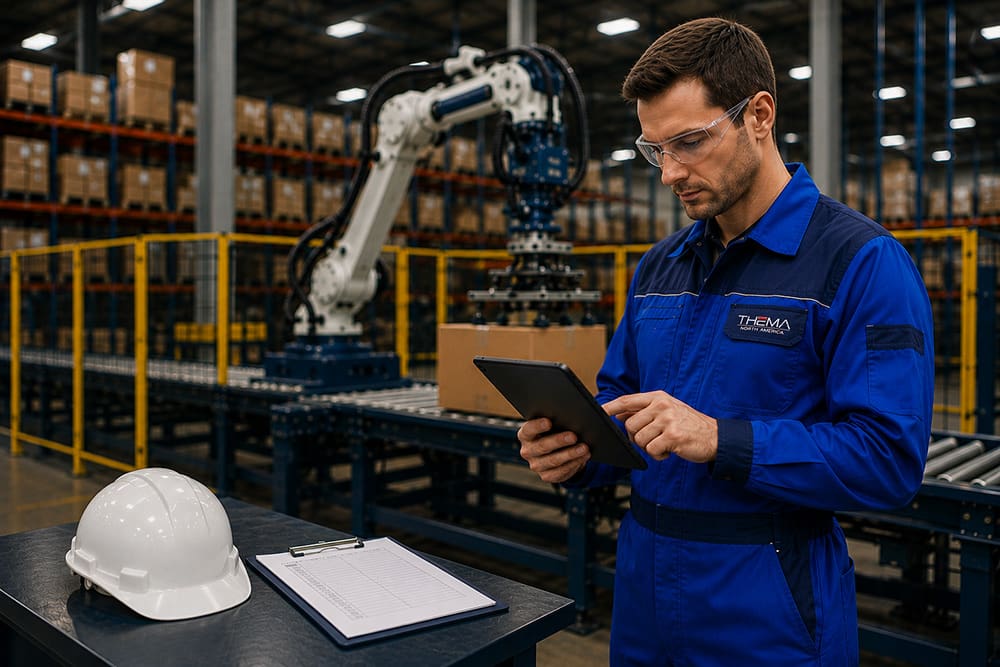
If you are selecting an industrial manipulator, start with the task instead of the machine. The right mount depends on where the load starts, where it has to end, how often the lift repeats, how much reach and twist the operator faces, and whether the work cell stays fixed or changes often. In most plants, floor-mounted and column-mounted systems fit dedicated stations, overhead rail fits longer travel paths, and movable bases fit changing cells after the load path and ergonomics are mapped.
What should you map before you pick a mount?
Before comparing floor, column, overhead, or movable configurations, document the lift itself. That means the pickup height, set-down height, horizontal reach, travel path, rotation needs, operator position, and cycle frequency. The federal Applications Manual for the Revised NIOSH Lifting Equation treats horizontal location, vertical travel distance, asymmetry, frequency, and coupling as core variables in lifting risk. Even if you are replacing manual handling with a manipulator, those same variables still tell you what the machine must reach, where it must be positioned, and how the operator will interact with it.
NIOSH also recommends reducing awkward postures, removing long carries, and using machines for lifting and lowering in its Ergonomic Guidelines for Manual Material Handling. That matters because a mounting decision is really a layout decision: are you trying to serve one repeatable station, multiple points in a cell, or a changing work area?
A practical cross-check comes from Washington State Labor & Industries. Its guidance on Solutions for Sprains & Strains notes that lifting from the floor increases back-injury risk compared with lifting at waist level, and that shorter reaches reduce strain. For a buyer, that means mounting should help keep the operator close to the load path and avoid forcing every cycle to start low, far away, or twisted.
When does a floor-mounted manipulator make sense?
A floor-mounted manipulator is usually the simplest fit when one workstation handles a consistent task with stable pickup and drop-off points. If the cell layout is fixed and the operator does not need to travel far beyond a defined area, a floor-mounted solution can be a strong starting point.
This approach is often attractive when you want a dedicated ergonomic lifting station for one product family, one palletizing area, one machine-tending point, or one assembly operation. THEMA’s Products page lists floor-mounted manipulators among its public mounting options, alongside column-mounted and overhead rail configurations. That makes floor mounting a useful option to evaluate first when the process is steady and the work envelope is well understood.
The main question is not whether floor mounting is “good,” but whether the floor location lets the operator stay inside the most efficient reach path throughout the cycle. If the operator still has to chase the load, twist around obstacles, or work from multiple pickup points, another mount may fit better.
When should you look at column-mounted or overhead rail systems?
Column-mounted manipulators
Column-mounted systems are worth evaluating when you still have a dedicated station but need a cleaner working envelope around the task. They can make sense when the manipulator has to serve a broader arc around one area, or when a floor pedestal is not the best fit for the surrounding workflow.
On THEMA’s Products page, column-mounted manipulators are presented as a standard public option. For buyers, that means column mounting should be part of the early comparison whenever one station needs broad reach without turning the task into a long manual carry.
Overhead rail manipulators
Overhead rail configurations become more relevant when the load path extends across a longer line or several handling points. If the work requires movement across multiple pickup and set-down locations, an overhead rail conversation may be more productive than trying to stretch one fixed station too far. THEMA also lists overhead rail manipulators on its public Products page, which makes them a legitimate selection path rather than a custom afterthought.
The key test is simple: if the process asks the operator to cover distance, serve more than one point efficiently, or keep floor space clearer around the station, overhead rail deserves an early review.
Do you need a movable base instead?
Some plants do not have one permanent handling cell. Changeovers, seasonal packaging, pilot lines, or shifting production priorities can make a fixed mount less attractive. In those cases, mobility may matter more than dedicating one station.
THEMA’s public Products page also identifies moveable manipulator options, including pallet-jack and forklift-base concepts. That is useful for buyers who need one manipulator to support more than one area over time. If your process changes location more often than it repeats in one place, a movable-base conversation can be more realistic than forcing a permanent mount into an operation that will not stay put.
That said, mobility should solve a real planning problem. If the job is repetitive, fixed, and predictable, a dedicated mount may still be the more efficient specification. Movable bases are most useful when flexibility is a requirement, not just a preference.
How should THEMA fit into the final specification conversation?
Once the layout questions are clear, the next step is matching mount, reach, payload, and gripping method to the application. THEMA’s public Pneumatic Manipulators page describes compressed-air manipulators with load capacities from 60 kg to 1,850 kg, reaches up to 6 meters, and multiple gripper approaches for boxes, bags, rolls, drums, and other materials. That matters because the right mount is only one part of the specification; payload, reach, and end-of-arm tooling still have to line up with the real task.
THEMA’s public Installation page also lays out a practical process: consultation and site assessment, customized planning, installation and commissioning, and operator training. For a buyer, that is the right sequence. First map the task. Then compare the mounting envelope. Then confirm how the manipulator will be positioned, commissioned, and handed over for day-one use.
If you are narrowing options now, collect these inputs before requesting a proposal:
- actual payload range, not just the heaviest theoretical load
- pickup and set-down heights
- required horizontal reach and travel path
- whether the operator must rotate, tilt, or reorient the load
- whether the workstation is fixed, multi-point, or frequently reconfigured
- what type of product contact the gripper will need
That information will make the mounting discussion far more useful than asking for a generic manipulator quote. If you want to move from comparison to application review, THEMA’s Request a Quote page is the natural next step.
The short version is this: choose the mount that supports the real load path with the least reach, least twist, and least unnecessary travel. Then size the manipulator around payload, reach, and gripping requirements. That is how a mount choice becomes a better material-handling system, not just a piece of equipment.