
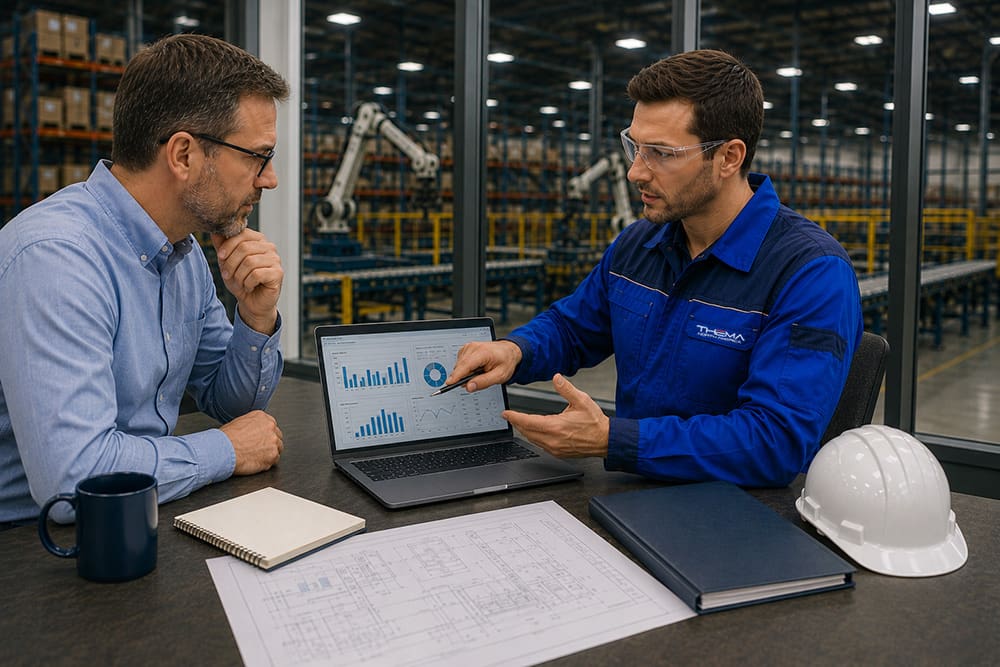
Short answer: Before you request a pneumatic manipulator quote, document seven things: actual load weight range, part geometry, pickup points, required orientations, travel path, cycle rate, and environmental or safety constraints. Those details determine whether you need a standard lift assist, custom end-of-arm tooling, or a broader workflow review, and they help prevent an under-scoped system that looks acceptable on paper but struggles in production.
What information does a supplier need to specify a pneumatic manipulator?
A supplier or integrator cannot specify a useful system from a vague request like “we lift boxes” or “we need help with drums.” The scoping package has to describe the task in enough detail to match the manipulator, tooling, and operator interaction to the real job. On THEMA North America’s Pneumatic Manipulators page, the company describes compressed-air systems configured with tooling such as vacuum cups, jaws, expanding mandrels, and magnetic heads for different load types. That means the part and the pickup method matter as much as the weight.
There is also a human-factors reason to scope carefully. In the NIOSH Applications Manual for the Revised NIOSH Lifting Equation, lifting risk is evaluated using more than pounds alone, including reach, height, travel distance, asymmetry, frequency, and coupling. OSHA’s ergonomics guidance frames the goal similarly: fit the job to the worker. For manipulator selection, that translates into designing around the motion, reach, grip quality, and repetition of the task, not just maximum capacity.
1. Define the load like an engineer, not like a buyer
Start with the real load envelope. Document the lightest and heaviest versions of the part, the dimensions, whether the center of gravity shifts, and whether the surface can tolerate clamping, suction, or magnetic contact. If the part is a family of SKUs, note the full range, not only the most common item.
This step matters because end-of-arm tooling usually decides whether the application feels stable and predictable to the operator. A drum, bag, roll, machined casting, carton, or glass panel may all weigh roughly the same, but they require different engagement methods and different levels of control during lift, rotation, and placement.
Minimum load data to collect
- Weight range, not just nominal weight
- Part dimensions and shape
- Pickup points or acceptable contact surfaces
- Whether the load is rigid, flexible, slippery, fragile, or porous
- Whether the load changes as product is consumed, filled, or emptied
2. Map the motion, not just the start and end points
Many applications fail during layout review because the buyer documented where the part begins and where it finishes, but not how it has to move between those points. A manipulator may need to lift straight up, clear guarding, rotate 90 degrees, pass through a narrow opening, and lower into a fixture with limited visibility. That is a different problem from simply moving the same part three feet across a table.
Write down the pick height, place height, horizontal reach, any required rotation or tilt, and any obstructions that restrict access. If the operator has to reach around posts, into racks, over conveyors, or inside machines, those constraints should be visible before anyone recommends a model or gripper.
This is also where cycle rate matters. A lift that happens once every 30 minutes can tolerate more manual setup than a task repeated every minute across an entire shift. If the motion is repetitive, the handling path needs to be efficient, stable, and easy to repeat without unnecessary body strain.
3. Evaluate the operator’s job, not only the machine’s job
Manipulator selection is not only a capacity exercise. It is an operator-interface exercise. The system should reduce force, awkward reach, twisting, and fatigue exposure in the real workstation. OSHA’s ergonomics guidance is useful here because it focuses on fitting the task to the worker rather than expecting the worker to overcome a poor task design. A quote request should therefore include who performs the task, how many times per shift, and where discomfort or control problems happen today.
THEMA’s Practical Workflow Optimization Assessment is helpful evidence of what good discovery looks like. The page explains that THEMA evaluates workflow observation, material flow, ergonomic risk identification, bottlenecks, and ROI opportunities instead of starting with a product recommendation. That is a strong model for buyers: if you cannot clearly describe the operator pain point, you may need an assessment before you need a model number.
Questions worth answering up front
- Is the task limited by lift force, awkward posture, visibility, or all three?
- Does the operator need one-handed guidance or two-handed control?
- Is precise placement required at the end of travel?
- Does the part block sight lines during pick or place?
- Do different operators run the station across shifts?
4. Check utilities, environment, and maintenance expectations
Pneumatic manipulators use compressed air, so air availability and routing need to be part of the discussion early. Environmental conditions matter too. Dust, washdown requirements, sensitive product areas, temperature swings, and housekeeping expectations can all affect tooling, component choices, and service access.
Maintenance expectations also deserve early attention. A buyer who wants the simplest possible support model should say so. THEMA’s product and service pages emphasize practical operation and support, including compressed-air manipulators and a dedicated Maintenance Program for ongoing machine care. That does not replace application scoping, but it does show that long-term serviceability is part of the buying decision, not an afterthought.
If your team already knows that uptime, sanitation sensitivity, or service simplicity is a deciding factor, make that explicit in the request. It can change the recommendation even when two solutions appear equivalent on lifting capacity alone.
5. Do you need a manipulator quote, or do you need a workflow assessment first?
This is the question many industrial buyers skip. If the application is straightforward, with a known part, stable layout, clear pickup method, and obvious handling path, a quote request may be the right next step. If the task involves multiple SKUs, recurring ergonomic complaints, bottlenecks between stations, unclear placement geometry, or several possible improvement paths, a workflow assessment may create more value than pushing immediately to equipment selection.
That distinction matters commercially. A good assessment can prevent a buyer from specifying the wrong tool for the real constraint. Sometimes the answer is a pneumatic manipulator. Sometimes it is different end-of-arm tooling, a workstation change, a conveyor adjustment, or a broader material-flow improvement. THEMA’s workflow-first positioning is useful here because it gives buyers permission to solve the operational problem before locking into a hardware assumption.
What should you send before requesting a quote?
If you want a faster and more useful first conversation, send a short scoping packet instead of a one-line inquiry. Include:
- Photos or video of the current task
- Load weights, dimensions, and SKU variation
- Required pickup surfaces and orientations
- Pick and place heights, reach, and obstructions
- Cycle rate and shift pattern
- Current pain points such as fatigue, dropped parts, slow placement, or safety concern
- Environmental notes such as washdown, dust, or product sensitivity
That level of detail helps a supplier decide whether the next step should be a quote, a site review, or a broader workflow conversation. It also improves the odds that the recommendation will match the real production requirement instead of a simplified version of it.
Bottom line
The best pneumatic manipulator projects usually start with better questions, not faster quoting. If you can define the load, map the motion, describe the operator challenge, and flag the environmental and maintenance constraints, you give the supplier a real basis for specifying equipment. If you cannot, that is often a sign to start with THEMA’s workflow assessment process or review the company’s pneumatic manipulator solutions before requesting a final recommendation.